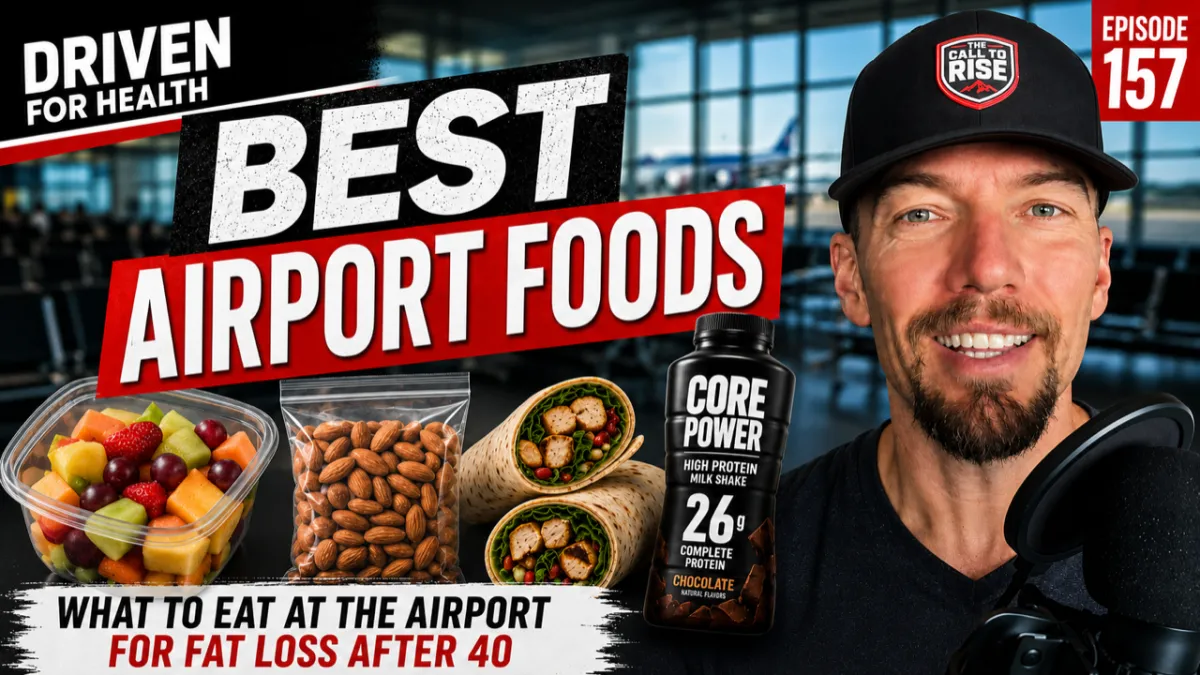
How To Eat At The Airport Without Wrecking Your Week
Most men plan the flight and leave the food to chance. The delays stack up and the only thing left open is a burger joint with a line out the door. This post covers how to plan a travel day so your food survives the delays you do not control.
A two-hour flight can turn into a seven-hour food problem. The delays stack up and the meal you counted on never arrives. This episode covers how to plan a full travel day so you land fed instead of famished.
The Question To Ask Before You Leave The House
Most men handle a travel day the same way every trip. They wing it. They scan the terminal and pick whatever sits closest to the gate.
There is one question that fixes this. When is my next reliable meal?
Answer it before you leave the house and the rest of the day gets easier.
Under three hours means water and a backup snack. You can also pack a real meal and bring it with you.
Three to six hours means one real meal planned on purpose. That meal can happen at the airport or after you land. It has to be planned either way.
Six hours or more means that meal plus delay insurance. Delay insurance is something shelf stable that zips into a bag. A protein bar works. A bag of jerky works.
You are not eating that item on a normal travel day. It sits in the bag for the day that falls apart.
Why The Airport Is Harder Than The Gas Station
Episode 156 covered gas stations. A gas station tests one skill. You read a nutrition label at a fast pit stop and pick a better option off the shelf.
An airport tests a harder one. It tests whether you can plan against a deadline you do not control.
You know roughly when you leave the house. You know how long the drive takes and how long the gate walk takes. Then the board flashes a delay and adds thirty minutes. Then the plane sits on the tarmac and adds forty more.
None of that is in your plan. The food has to survive it anyway.
TSA Or Toss
Solid food clears security with no size limit. Sandwiches and wraps clear. So do hard-boiled eggs, firm cheese, jerky, nuts, protein bars and whole fruit.
Liquids are where men lose food at the checkpoint.
Every liquid, gel, cream or spreadable food goes in a container of 3.4 ounces or less. All of those containers have to fit inside one quart-sized bag. You get one bag per person and not one bag per item.
Peanut butter counts as a liquid. Your sandwich might disagree and TSA wins that argument. Greek yogurt, hummus and salad dressing land in the same category.
Buy peanut butter in individual packets rather than carrying a tub.
A pre-made protein shake is over 3.4 ounces. It goes in the trash at the checkpoint.
Powders
Protein powder and creatine are allowed in carry-on bags and checked bags.
More than 12 ounces or 350 millilitres goes in a separate bin for X-ray screening. Expect some extra scanning on it.
TSA recommends putting non-essential powders over that amount in a checked bag. Original packaging is not required. A label makes the conversation shorter.
Ice Packs And Water
A frozen gel pack only works if it is fully solid when you reach the checkpoint. Partly melted counts as a liquid and drops back to the 3.4 ounce rule.
Empty water bottles clear security. A full one does not. Fill it after you are through.
Fruit
Fresh fruit clears TSA on domestic flights inside the country. An apple or a banana alongside a sandwich is a solid travel meal.
Flying home from Hawaii, Puerto Rico or the US Virgin Islands is different. Agricultural restrictions apply and fruit may not be allowed. Check before you pack it.
Taking agricultural products out of the country is a separate matter. You have to declare them to customs. The fines are steep.
Food Safety In Your Bag
Clearing security does not mean your sandwich is still good five hours later.
USDA guidance is short. Perishable food should not sit unrefrigerated for more than two hours. Above 90 degrees that window drops to one hour.
USDA calls this the temperature danger zone. Bacteria grow inside it and your stomach pays for it later.
An insulated bag buys you time. So does planning to eat the food early in the day rather than late.
The Terminal Awards
Best full meal goes to a customizable bowl or salad or protein plate. You pick the base and the protein. You control the portion instead of accepting whatever size they hand you.
Best chain fallback goes to Chick-fil-A. Grilled nuggets work when they are serving them. A grilled chicken sandwich with a fruit cup works too. That gives you protein and fiber without setting up an overeat.
Best emergency purchase goes to protein plus fruit. A protein shake with a piece of fruit is the ideal version. A protein bar with a piece of fruit covers it. Either one beats the pastry sitting at the register.
Biggest health halo trap goes to the smoothie counter. The word smoothie reads as healthy. The calories and the sugar run much higher than men expect. Read the total before you order.
If you sit down at a restaurant you can still order a la carte. Ask for the burger with no bun. Ask for a salad instead of fries. Expect to pay around $20 for that experience. A build-your-own line usually costs less and gives you more control.
The Lounge
Lounge access changes a long travel day. Sort it out before the trip rather than at the desk.
Look for the protein first. Fill up on the vegetable-heavy options next.
Stick to zero calorie drinks or coffee. Cap alcohol at one or two.
Lounges use small plates and that helps. A small plate gives you a reasonable portion without a decision.
The traps sit together in one corner. Desserts, breads, donuts, cookies and pastries. Higher calorie alcohol served in large glasses.
Getting your money's worth is fair. Going past a thousand calories in the lounge undoes the rest of the plan.
On The Plane
Short flights are simple. Take a low calorie drink and the pretzel if you want it. That fits inside a normal day. You can also decline the cart and hold to the plan you made.
Long flights need more. A snack box works if you pick and choose what you eat out of it. Some airlines sell fresh meals you can pre-order before the flight.
Food also tastes different in the air. Lower cabin pressure dulls both taste and smell. Cabin noise adds to the effect. That is why airline food often arrives heavily salted or heavily sweetened.
The First Meal After You Land
Decide this before the wheels touch down. Are you eating at the airport, on the way, or at the destination?
Look up what is near your hotel ahead of time. A grocery store run works. So does a delivery order to the room.
A client I worked with used to plan her delivery order before she flew. She checked whether the room had a refrigerator so she could keep real food on hand all week.
Pilots and flight attendants do the same thing at a larger scale. They bring days of food with them rather than buying every meal in a terminal.
Travel Early
Chris from episode 117 travels for work and he is one of my guys. His rule is to take the first flight of the day.
The chance of a delay only goes up as the day goes on. An early departure gives the rest of your plan somewhere to absorb the damage.
Action Steps
- Ask when your next reliable meal is before you leave the house.
- Pack solid food. It clears security with no size limit.
- Keep every liquid to 3.4 ounces inside one quart-sized bag.
- Carry one shelf-stable item as delay insurance on long travel days.
- Eat protein first in the lounge and cap the alcohol.
- Decide your first landing meal before you land.
- Send questions to [email protected].
More From Driven For Health
- Episode 156 covers what to order at a gas station.
- Episode 145 opened the what-to-order series with Chipotle.
- Episode 117 features Chris and his travel-early rule.
Get The Guide
I built a whole system around eating on the road. It covers gas stations, airports, fast food and sit-down restaurants in one place.
Grab the Eating On-The-Go Guide at go.brianparana.com/eatingonthego. Click the red button and the guide downloads right then.
The Call To Rise
The Call To Rise is a 100-day Fat Loss Challenge designed for driven men ready to get back to a healthy body, boost their energy, and lead as a powerful man.
If you are struggling with some form of chronic illness such as high blood pressure, cholesterol or even Type 2 Diabetes - this program is designed for you too.
Through a proven system of strength training, personalized nutrition, and real accountability, most men lose 20 plus pounds and rebuild the confidence that comes with it and even improve chronic illness issues. It's more than a fitness program, it's a body transformation experience with a Brotherhood of like-minded men committed to showing up, leveling up, and leading in a body they are excited about.
This is your wake-up call to rise.
www.thecalltorise.com
Frequently Asked Questions
What food can you bring through TSA security?
Solid food clears security with no size limit. Sandwiches, hard-boiled eggs, firm cheese, jerky, nuts, protein bars and whole fruit all pass on domestic flights.
How much liquid can you bring through airport security?
Every liquid, gel, cream or spreadable food has to be in a container of 3.4 ounces or less. Those containers all have to fit inside one quart-sized bag, and you get one bag per person rather than one per item.
Can you bring protein powder on a plane?
Yes. Protein powder and creatine are allowed in both carry-on and checked bags. Anything over 12 ounces or 350 millilitres goes in a separate bin for X-ray screening.
Can you bring fresh fruit through TSA?
Fresh fruit clears TSA on domestic flights inside the country. Flying to the mainland from Hawaii, Puerto Rico or the US Virgin Islands is the exception. Agricultural restrictions apply there.
How long can food sit in your bag before it goes bad?
USDA guidance says perishable food should not sit unrefrigerated for more than two hours. Above 90 degrees that drops to one hour.
What is the best thing to eat at an airport?
A customizable bowl or protein plate where you pick the base and control the portion. A grilled chicken option from a familiar chain is the next best fallback.
How do you eat at an airport lounge without overeating?
Fill the plate with protein and vegetables first and use the small plates the lounge provides. Cap alcohol at one or two and stay away from the pastry table.
What is the Call To Rise program?
The Call To Rise is a 100-day fat loss challenge built around strength training, personalized nutrition and real accountability. Most men lose 20 plus pounds and rebuild the confidence that comes with it.