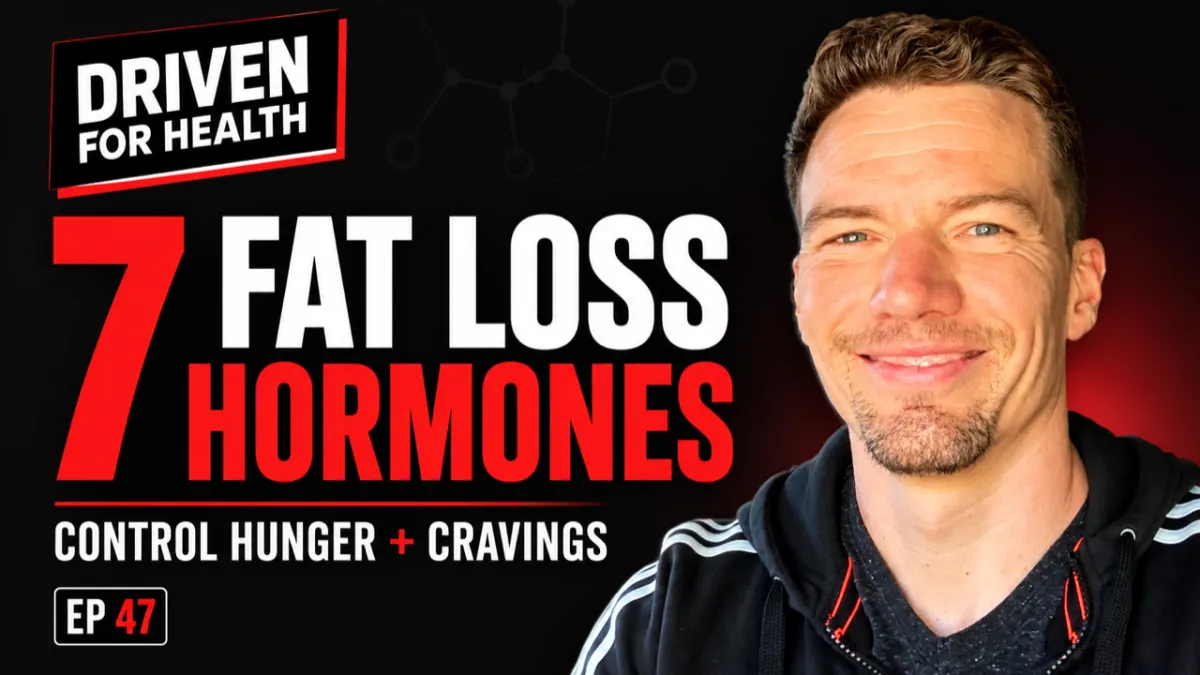
The Seven Hormones Behind Stubborn Fat Loss in Men Over 40
A man can eat well all week and train four days and still watch the scale sit for months. Seven hormones sit between his effort and his result, and they move hunger, cravings, energy, and where fat gets stored. This post covers what each one does and the inputs that change it.
Fat loss gets harder for a lot of men after 40, and most of them assume the problem is effort. Episode 47 walks through the seven hormones that move hunger and cravings and energy and where the body stores fat. It also covers what changes each one. Listen to Episode 47 for the full breakdown.
Coach Brian is a coach and not a doctor. Nothing here is medical advice.
The Formula Behind Every Stall
Calories still matter. When a man is in a real calorie deficit, he loses weight almost every time. When a man says he cannot lose weight and nothing is working, the usual answer is that he is not in a deficit at all.
Coach Brian's definition of a real deficit is narrow on purpose. It means eating your calories across all the days, not most of the days. Eating clean Monday through Thursday and erasing the whole week Friday through Sunday leaves the scale exactly where it was.
Hormones do not make weight loss impossible. They make it harder. They raise hunger, raise cravings, drop energy, and interfere with sleep. They also cut how much you move without you noticing, and they change how many calories you burn.
That is why the episode uses a longer formula:
Weight loss = Calories + Hormones + Behavior Consistency
Hormones do not override physics. They influence both sides of the calorie equation. On the intake side they move appetite, cravings, fullness, and impulse control. On the output side they move metabolism, non-exercise activity, training performance, and recovery.
How to Tell Whether Hormones Are Part of Your Problem
Two sources of evidence matter here, and the episode leans on both.
The first is blood work. Coach Brian's position is that every man over 40 should get labs at least once a year, covering thyroid, testosterone, cortisol, insulin markers, cholesterol, and A1C. Know your numbers before you argue about them.
The second is how you feel day to day. As you read the seven hormones below, the question worth asking on each one is whether you recognise yourself in it. Your body is already reporting.
Hormone 1: GLP-1, Your Appetite Control System
GLP-1 stands for glucagon-like peptide-1. It is made in your gut and it works as your appetite control system. Coach Brian describes it as the brakes on appetite rather than the gas pedal. It tells your brain you have had enough. This is also the peptide that medications like Ozempic, Wegovy, and Mounjaro stimulate.
When GLP-1 is doing its job you feel full and satisfied after a meal. When it is not, you feel hungry all day even after eating.
The analogy in the episode is the delivered notification on a text message. Eat slowly and the message reaches your brain on time. Inhale your food and the message lands late, after you have already eaten past full.
What moves GLP-1 without a prescription
Water. Coach Brian's baseline is half your body weight in ounces per day. Hunger gets much louder when you are under-hydrated. His own first move when hunger hits is eight ounces of water. Half the time the signal turns out to be thirst.
Protein. Protein raises GLP-1 naturally, holds fullness longer, and steadies blood sugar. He treats it as non-negotiable.
Fiber. Fiber adds volume to a meal and slows digestion. In this episode his range for a man in a fat loss phase is 15 to 25 grams a day.
Eating pace. This is where he says most men lose the meal. Eating between meetings, eating in the car, eating while answering email. His target is 15 to 20 minutes at the table instead of five. Put the phone down and give your body time to register the meal.
Fermented foods. Greek yogurt and cottage cheese support gut health and GLP-1.
Exercise and sleep. Both improve GLP-1 function, and both are on his non-negotiable list.
Victor Lost 21 Pounds and Then Nothing Moved for Four Months
Victor needed to lose 43 pounds. He lost 21 and then stopped cold. Four months with no movement on the scale and no change in the photos or at the waist. He swore he had not changed a thing.
Early on, while the weight was coming off, he felt hopeful and back in control. The stall took that away. He was waking up thinking about food and going to bed thinking about food. At work he was irritable and short-fused and distracted. At home he was edgy and restless and not present with his family. He described the whole day as white-knuckling, and he felt like he was starving all the time.
His metabolism was not broken. He was running his fat loss in a way that turned the volume up on hunger and cravings and turned it down on energy and patience.
The fix was the basics. Hydration, protein, fiber, slower eating, and sleep. The stall moved after that. What mattered more to Victor was that his head calmed down, and he stopped feeling like he was fighting himself all day.
That gap is the whole point of the episode. Chasing calories is one thing. Managing the hormones that decide whether those calories feel easy or impossible is another.
Hormone 2: Cortisol, Your Stress Responder
Cortisol is your stress hormone and your fight-or-flight signal. Plenty of men live in that state permanently. When cortisol stays high for too long because of your job or your schedule or your lack of sleep, it works against your fat loss.
High cortisol drives weight gain around the stomach. That is visceral fat and it is the dangerous kind. It pushes cravings toward sugary and fatty food. It drains energy, so you move less.
The analogy is a smoke alarm. Useful when there is a real fire. When it screams all day every day, you cannot relax or focus, and you start making poor decisions to get relief.
The indirect route matters
Cortisol does not stop fat loss directly. It works on calories consumed and calories burned. More stress means more cravings and more hunger. More stress also means less energy, so you move less. Bring stress down and you get the reverse on both sides.
What lowers cortisol
Sleep. Seven-plus hours a night. Coach Brian puts this first. A man running on five or six hours is chronically stressed because he is chronically tired.
Things that fill your cup. Most men run work to home to work to home with nothing else in it. If doing something for yourself lowers cortisol and lower cortisol helps fat loss, then a massage or a hike or a day at the beach or time with your friends belongs in the plan rather than outside it.
Caffeine control. Anything over 400 milligrams a day needs reining in, and so does caffeine taken late. Overused caffeine spikes cortisol.
Sunlight and a walk outside. Both lower stress hormones naturally.
A wind-down routine. Plenty of men go to bed and then scroll until midnight. Going to bed is not the same as falling asleep.
The part men do not want to hear
You can carry high stress through a season. A few months, or six at the outside. When the season becomes the lifestyle and you look back on two or three years of it, that is a lifestyle problem, and it may be the main reason your fat loss stopped.
Mark was working 70-hour weeks. He was eating clean and hitting the gym four days a week and could not drop a pound. His food did not change and his workouts did not change. His boundaries changed, his sleep changed, and he stopped answering email at 10 PM. The weight started moving within three weeks.
Hormone 3: Thyroid, Your Metabolism Thermostat
Your thyroid controls your metabolism. Think of the thermostat in your house. Turn it down and everything runs slower. Turn it up and everything runs faster. Your thyroid is telling your cells how fast to work, and when it is out of balance it affects weight, metabolism, mood, and energy.
Here is the part most men miss. Your thyroid slows down as you lose weight, and that is normal. Lose 20 or 30 pounds in a fat loss phase and your thyroid output and your metabolism both come down with it. That is biology rather than a malfunction.
A 300-pound man's body works extremely hard to run basic functions, so his metabolism can sit higher. As he gets lighter his body has less work to do, so metabolism slows. That is why fat loss slows or stalls as you get leaner.
The practical consequence is that you cannot live in a fat loss phase forever. You cycle it with maintenance, reverse dieting, and muscle building.
What supports thyroid function
Exercise and sleep. Both support healthy thyroid function.
Iodine-rich foods. Seafood and dairy give your thyroid its raw materials.
A cleaner plate. More single-ingredient, nutrient-dense food and less processed packaged food.
Selenium. Eggs, fish, and Brazil nuts. A handful of Brazil nuts a few times a week is his example.
Stress relief. Yoga if you like it, meditation, prayer, or deep breathing. Anything that calms you down.
Hormone 4: Leptin, Your Fullness Hormone
Leptin is the fullness hormone. Coach Brian's memory trick is that leptin equals full, and full has two Ls in it.
Leptin is made by your fat cells and it works like a fuel gauge. Working properly, it tells your brain there is enough stored energy on board and you can stop eating. It should lower hunger and raise the energy you burn.
The problem is that the gauge gets jammed. Carry too much body fat and eat past fullness often enough and the reading stops matching the tank. The tank is full and the gauge keeps saying empty, so you keep feeling like you need more. That is leptin resistance.
Two habits drive it. Overeating often, and eating calorie-dense food such as cookies, cake, pasta, and pizza that makes blowing past fullness easy.
Losing weight changes the signal too. Hunger at 30 pounds lighter is a different animal from hunger 30 pounds heavier, because your body registers the change. Coach Brian says he has watched dozens of clients lose 20 or 25 pounds and become hungrier than they were at the start. That is a hormone doing its job rather than a character flaw.
What supports leptin
Less sugar and less junk food. He puts this first.
Sleep. Poor sleep drags leptin down and raises hunger.
Metabolic health. Better blood markers and a lower body fat percentage.
Antioxidant-rich food. Berries and vegetables. His own daily go-to is Greek yogurt with berries, which gives him antioxidants and fiber from the berries and protein and fermented benefits from the yogurt.
Exercise and protein. Both support healthy leptin function.
Hormone 5: Ghrelin, Your Hunger Hormone
Ghrelin is the hunger hormone, and the memory trick is that ghrelin equals grumble. It is produced in your stomach and it tells your brain you need food. When your stomach growls, that is ghrelin talking.
The analogy that helps most men is a scheduled alarm clock. Eat at the same times every day and your body learns those times, then rings the bell before the meal arrives. That is a pattern rather than an emergency. In a fat loss phase ghrelin often gets louder, because your body is working to protect you from losing weight.
Coach Brian walks his own brain through it out loud when hunger gets big in a fat loss phase. His stomach is hungry, so ghrelin is up, and it is sending a signal rather than issuing a command. That sounds small and it creates space. Plenty of men feel hunger and panic, or feel hunger and read it as failure. Your body is doing what it is built to do.
What manages ghrelin
Protein at meals. This helps most. His picture is a slow-burning log on the fire instead of paper.
Fiber. It adds volume to the meal and slows digestion so fullness lasts longer.
Sleep. Bad sleep raises ghrelin and raises hunger with it.
Fewer processed foods. They digest fast and leave you hungry again.
Ghrelin and leptin are the two hunger hormones. Get those two handled and you have your appetite handled.
Hormone 6: Insulin, Your Blood Sugar Manager
Insulin is made in your pancreas and it works like a key. Its job is to open the door and move sugar out of your blood and into your muscle and liver cells to be used for energy. When insulin is off, you end up with type 2 diabetes.
When you are insulin sensitive the key turns smoothly. When you are insulin resistant the lock is rusty. The key still turns and it takes more effort and more insulin. When insulin runs too high too often, fat loss gets harder and visceral fat tends to rise.
Visceral fat is worth defining. Subcutaneous fat is the fat you can pinch. Visceral fat is the deep fat around your organs, and that is the one you do not want high, because it raises the risk of heart disease and diabetes and stroke.
What improves insulin sensitivity
Eat in a calorie deficit. Losing body fat improves insulin sensitivity.
Less sugar and fewer processed foods. These spike insulin over and over across the day.
Healthy fats. Fat does not make you fat. Calories do, and hormones influence calories in and calories out. Olive oil, avocado, and avocado oil are his examples of fats that help manage insulin.
Fiber. Fiber slows how fast sugar gets absorbed into your bloodstream. His arithmetic in this episode is about 14 grams of fiber for every 1,000 calories you eat, so a man eating 2,000 calories is looking at around 28 grams. For most men in a fat loss phase he calls 15 to 25 grams a solid range.
Exercise. Walking and lifting both improve insulin sensitivity.
Coach Brian describes a client whose A1C came back at 6.2, in the pre-diabetic range, with his doctor ready to start medication. They cleaned up his food, got him walking 8,000 steps a day, and started him lifting three times a week. Six months later his A1C read 5.4, in the normal range, with no medication. That is one man's result under coaching, not a promise, and the medication decision was always his doctor's to make.
Hormone 7: Estrogen and Testosterone
The seventh slot covers both sex hormones together, because the episode's point is the balance between them. Women need testosterone and men need estrogen, and what matters is having the right amount of each. Both affect weight, muscle mass, and where your body stores fat. Out of balance, losing weight gets much harder.
Low testosterone in men
Low testosterone makes fat loss feel like dragging a sled. Fat loss is not impossible, and your energy drops, your recovery drops, your drive to train drops, and your body holds onto fat more easily. Coach Brian sees this constantly with men in their 40s and 50s who are doing the right things and working twice as hard for half the result. Low testosterone also affects mood and focus and sex drive, so it reaches well past the gym.
Estrogen and where fat sits
When estrogen levels change, fat storage tends to move toward the midsection. That is why menopause changes body composition so fast, with fat moving from other areas toward the belly and toward visceral storage.
Testosterone helps build muscle and burn body fat. Estrogen has more to do with storage patterns. Both affect how fast your body burns calories, and both affect mood and energy.
What supports them naturally
Vitamin D. From sunlight or a supplement. He notes that a lot of people in North America are low in vitamin D and magnesium.
Anti-inflammatory foods. Vegetables and berries.
Enough protein. Protein supports muscle mass, and muscle mass supports testosterone.
Lifting weights. Lifting raises testosterone and helps with estrogen balance.
Stress management. High cortisol pulls testosterone down, which loops back to hormone number two.
Dropping body fat. Hormone levels can improve as body fat comes down, testosterone especially.
Coach Brian says he has had clients whose testosterone moved from 350 to 550 after losing 30 pounds and lifting consistently, with no TRT involved. That is what he has seen in his own coaching. Your labs and your care belong to you and your clinician.
When the Fundamentals Are Not Enough
These seven hormones work together, and one number being off does not doom anyone. Sleep, hydration, stress, movement, and whole foods give you real influence over all of them.
There are also cases where lifestyle alone does not get there. That means blood work and a clinician, and it may mean TRT or thyroid medication. Coach Brian's position on that is short. Sometimes that is the right call, and for most men the fundamentals move the needle first.
Coach Brian is a coach and not a doctor. Nothing here is medical advice. Any decision about testing, medication, or hormone therapy belongs between you and your physician.
The Action Plan From Episode 47
- Get your labs. Coach Brian wants every man over 40 tested at least once a year, covering thyroid, testosterone, cortisol, insulin markers, cholesterol, and A1C.
- Sleep seven-plus hours. He calls this non-negotiable.
- Drink half your body weight in ounces of water per day.
- Deal with your stress on purpose. Guard your mental health and put something in the week that is yours.
- Move regularly. Walk and lift and stay active.
- Eat mainly whole foods. Nutrient-dense, single-ingredient food, with less processed packaged food.
Common Mistakes Men Make With Hormones
Treating a hormone as a verdict. A flagged marker is information about what to work on. It is not a sentence.
Blaming a hormone for a deficit that was never there. Most stalls trace back to eating your calories on some days and not others.
Reading normal biology as damage. Metabolism slowing as you get leaner is expected. Hunger rising after you drop 20 or 25 pounds is expected too.
Fixing food while ignoring sleep and stress. Mark's food was already clean. His hours and his sleep were the problem.
Staying in a fat loss phase permanently. Cycle it with maintenance, reverse dieting, and muscle building.
Who This Episode Is For
This is for the man over 40 who has been consistent enough to expect results and is not getting them. His hunger runs loud all day, his energy is flat, and he has started to suspect his body is working against him.
It is not for the man looking for permission to stop. The episode is explicit that hormones are not a reason you are off the hook.
More From Driven For Health
- Episode 46: Bad Blood Work After 40, What Men Should Do to Improve It
- Episode 57: Food Noise, Why Men Over 40 Think About Food All Day
- Episode 89: I Just Got Diagnosed With Type 2 Diabetes, Now What
- Episode 95: If You Have Type 2 Diabetes Your Liver Is Sabotaging Your Blood Sugar
- Episode 102: Men Over 40 Fitness, Testosterone, And Health With Funk Roberts
- Episode 111: The Sleep Talk Every Man Over 40 Needs to Hear
- Episode 121: GLP-1s, The Good, the Bad, and the Ugly
Call to Action
Your labs are the fastest way to find out which of these hormones is worth your attention. The free Improve Your Blood Panels Scorecard puts your blood work in plain English. It covers A1C, cholesterol, blood pressure, and triglycerides, plus the daily habits that move each one. It also includes the Metabolic Reset Protocol, a three-day structure covering what to eat and how much to move and how to hydrate. Download it at brianparana.short.gy/improveyourbloodpanels.
The Call To Rise is a 100-day Fat Loss Challenge designed for driven men ready to get back to a healthy body, boost their energy, and lead as a powerful man.
If you are struggling with some form of chronic illness such as high blood pressure, cholesterol or even Type 2 Diabetes - this program is designed for you too.
Through a proven system of strength training, personalized nutrition, and real accountability, most men lose 20 plus pounds and rebuild the confidence that comes with it and even improve chronic illness issues. It's more than a fitness program, it's a body transformation experience with a Brotherhood of like-minded men committed to showing up, leveling up, and leading in a body they are excited about.
This is your wake-up call to rise.
www.thecalltorise.com
The guarantee is one sentence. Lose 20 or more pounds in the 100 days, or Coach Brian keeps working with you until you do. Apply at thecalltorise.com.
Frequently Asked Questions
What are the 7 weight loss hormones for men?
Episode 47 covers GLP-1 for appetite control, cortisol for stress, thyroid for metabolism, leptin for fullness, ghrelin for hunger, insulin for blood sugar and fat storage, and estrogen with testosterone for body composition. The seventh slot covers both sex hormones together, because what matters there is the balance between them.
Can hormones stop you from losing weight?
Hormones do not make weight loss impossible and they do make it harder. They raise hunger and cravings, drop your energy, interfere with your sleep, and cut how much you move without you noticing. Coach Brian's formula on the episode is calories plus hormones plus behavior consistency, and most stalls still trace back to eating your calories on some days and not others.
How do you increase GLP-1 naturally?
GLP-1 is your appetite control system, and Coach Brian's levers are water at half your body weight in ounces a day, protein at meals, fiber, slowing your eating down to 15 to 20 minutes instead of five, fermented foods like Greek yogurt and cottage cheese, and regular exercise and sleep. GLP-1 is also the peptide that medications like Ozempic and Wegovy and Mounjaro stimulate, which is a conversation for your doctor.
Does cortisol cause belly fat in men?
High cortisol drives weight gain around the stomach, and that visceral fat is the dangerous kind. It works indirectly, by raising cravings and hunger on one side and draining the energy you need to move on the other. Sleep of seven-plus hours, caffeine under 400 milligrams a day, sunlight, a walk outside, and a real wind-down routine are what Coach Brian uses against it.
Why am I hungrier after losing weight?
Leptin is made by your fat cells and works like a fuel gauge, so losing body fat changes the reading and hunger comes back louder. Coach Brian says he has watched dozens of clients lose 20 or 25 pounds and end up hungrier than they were at the start. Your body is doing what it is built to do. Sleep and protein and fiber matter more in a deficit rather than less.
How much fiber should a man eat in a fat loss phase?
On this episode Coach Brian works from about 14 grams of fiber for every 1,000 calories, so a man eating 2,000 calories lands near 28 grams. For most men in a fat loss phase he calls 15 to 25 grams a day a solid range. Fiber adds volume, slows digestion, and slows how fast sugar reaches your bloodstream.
Can losing weight raise your testosterone?
Coach Brian says hormone levels can improve as body fat comes down, and he describes clients whose testosterone moved from 350 to 550 after losing 30 pounds and lifting consistently with no TRT. He also says plainly that lifestyle is not always enough, and that blood work and a clinician are the right next step when it is not. He is a coach and not a doctor, so treat any medication decision as your physician's call.
What is the Call To Rise program?
The Call To Rise is Coach Brian Parana's 100 day fat loss and health program for driven men over 40. Most men lose 20 plus pounds. The guarantee is one sentence. Lose 20 or more pounds in the 100 days, or Coach Brian keeps working with you until you do.