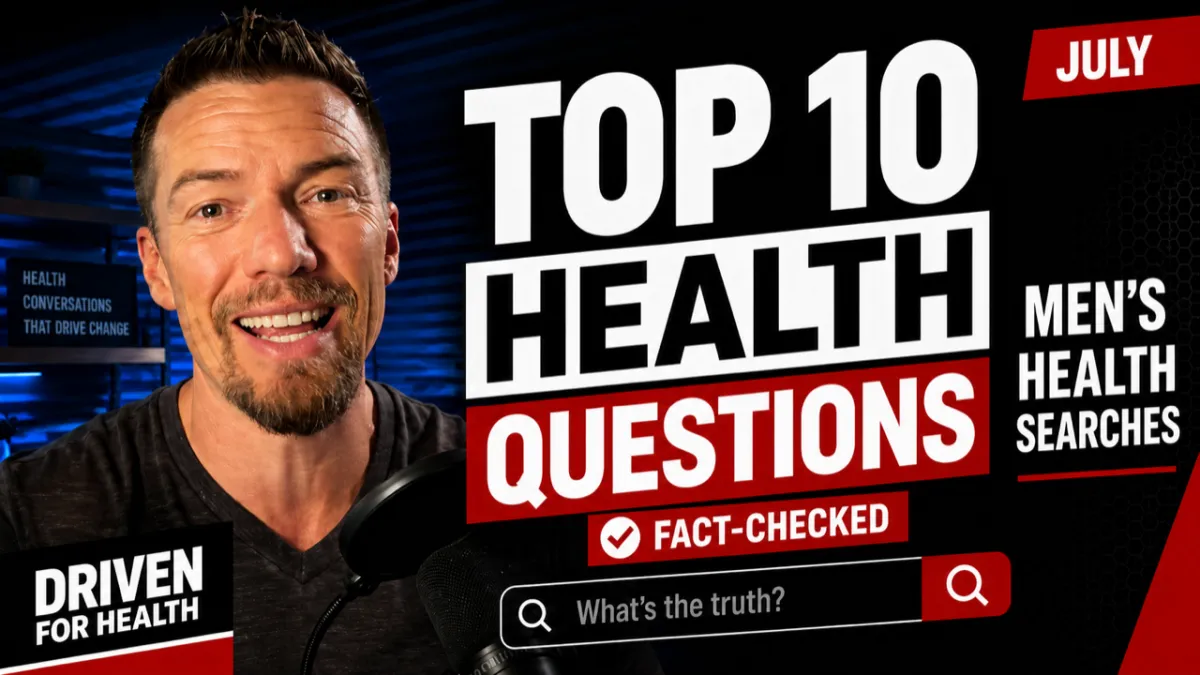
10 Health Questions Men Over 40 Google, Fact Checked
It is 11 at night and you type a health question into your phone. Six sites hand you six different answers. Coach Brian took the ten questions men over 40 searched most this month and went looking for the study behind each one.
Skip sex for seven days and your testosterone jumps 45 percent. That claim traces to a 2003 study of 28 men, and the paper was retracted. On July 19 Coach Brian pulled the ten health questions men his age were searching most and checked the research behind every answer. Listen to Episode 138 for all ten in under twenty minutes.
He is a coach and not a doctor, and none of this is medical advice.
The 45 Percent Testosterone Claim Comes From a Retracted Study
The claim runs on fitness forums, Reddit, supplement ads, and half the alpha male content in your feed.
In that 2003 study, testosterone spiked on day seven one time in a group of 28 men. It dropped back to baseline through continued abstinence out to 14 days. The paper was later retracted. Bad data was not the reason. The authors had already published the same work in a different journal.
No study since has repeated the finding. Snopes rates the 45 percent claim false and some later research shows no effect from abstinence at all.
Coach Brian's concern here goes past trivia. Men rebuild a whole week around a number that was never real, and the supplement aisle runs on the same fuel. Jamie lost 38 pounds in 100 days in The Call To Rise. Coach Brian banned him from buying supplements partway through, because he kept buying them and then asking what they did. Most carried no minimum viable dose worth taking. Jamie had spent hundreds of dollars chasing the physique in the advertisement.
Put that money and that attention into your training, your sleep, and your food.
The FDA Move on TRT, and What to Do Before You Chase a Prescription
For years a doctor could prescribe testosterone replacement therapy only when there was a clear physical cause behind the low testosterone. The worry was heart risk, plus men chasing a prescription for normal aging instead of a real medical problem. Plenty of men with real symptoms and low labs stayed locked out.
That is moving. The FDA invited TRT manufacturers to apply for a new approval covering low libido in men with unexplained low testosterone. Companies had until April 30, 2026 to say they were interested. The move follows an expert panel review from December 2025 that looked at real trial data.
Nothing is approved yet. Any approval still needs full clinical evidence that the benefits outweigh the risks.
So watch for fatigue, low drive, low mood, and wrecked sleep with no reason sitting behind it. If two or three of those sound like you, get your blood panels done before you go looking for a prescription off a headline. Then find a doctor who knows you and knows how to read hormones. The person reading the panel matters more than the person who ordered it.
Men chasing longevity test further than a standard physical goes. DEXA scans show a real muscle to fat ratio. Continuous glucose monitors track blood sugar all day. Expanded hormone panels go deeper than the basics. Hone Health's 2026 longevity survey found these are the tests longevity-focused providers recommend most.
Coach Brian flagged his own source on air, and the habit is worth copying. Hone Health is a telehealth company surveying doctors inside its own network, which makes it a company survey rather than a clinical study. The direction of the claim holds up against other 2026 longevity coverage.
You do not need all of those tests. A normal panel and an optimal panel are two different things. Run basic hormone and metabolic panels once a year and sit down with a doctor who understands the numbers.
GLP-1 Drugs Pull Muscle Off With the Fat
Ozempic and Wegovy take fat off fast. They take muscle with it when the protocol around them is wrong. The bill arrives months later as less strength and worse balance. Closer to 60 or 70 that setback costs a lot more.
Coach Brian covered the percentages on episode 123. Fifteen, twenty, or thirty percent of the weight lost can come from muscle. Muscle is metabolically active tissue, so losing it slows your metabolism down on its own. The amount of muscle on your body is also a leading determiner of all-cause mortality.
Stanford researchers tested a compound this year called MF-300. It helped preserve muscle repair in animals treated with GLP-1 drugs, and it is already past phase one safety trials in humans. Phase 2B trials are on deck for later this year. Stanford's lead researcher Helen Blau said there is a major unmet need for a drug that can help GLP-1 users preserve their muscle health and strength.
If you are on a GLP-1, resistance training is mandatory at least twice a week and three is better. Eat a minimum of 150 grams of protein a day. You will have to push through the appetite suppression and get it in anyway.
Cardiovascular Fitness Predicted Survival Better Than Most Diseases
A study in JAMA Network Open followed more than 122,000 patients. The fittest group had an 80 percent lower mortality risk than the least fit group. Having lower levels of cardiovascular fitness outranked diabetes, smoking, and existing heart disease as a risk factor for early death.
Your fitness level predicts survival better than most of the diseases men are scared of. It sits on your VO2 max, meaning how much oxygen your body can move and use.
Zone two is the pace that builds it. You ride or walk at an effort of roughly six or seven out of ten, easy enough to hold a conversation the whole way through.
Coach Brian has a client named Neil who is 44 and in business with three kids. Six months ago his legs burned when he climbed a ladder. A flight of stairs left him out of breath. They started with 30-minute zone two rides on a bike at an easy pace. The rides got longer as he progressed and the aches and the breathlessness that came with them stopped.
Add two 30-minute zone two sessions a week. Coach Brian ran 20 miles the day he recorded this episode at a pace easy enough to talk through. He is training for the Akron Marathon on September 27 after his oldest son Levi challenged him to sign up. He also keeps a desk bike under his computer and pedals at a heart rate around 120 to 130 while he works.
The 3-3-3 Gym Rule Landed Close to the Real Guidelines
The 3-3-3 rule is three days lifting, three days cardio, three days rest. It is all over social media dressed up as a new discovery.
The research lands close to it. The American College of Sports Medicine released new resistance training guidelines this year, their first update in 17 years. They are built on a meta-analysis of 137 studies covering more than 30,000 people.
Their number is to train each major muscle group at least twice a week. About 10 sets per muscle group per week if you are chasing growth. Twice a week with consistency over time beats any complicated split online.
A push, pull, legs rotation with three days of cardio and three days of rest will get you there. Coach Brian would rather build the routine around the man doing it. His experience, his schedule, and his circumstances decide the split.
Most Men Get About Half the Fiber They Need
The American Society of Nutrition found only 5 to 10 percent of men hit their recommended fiber intake. The real number is 14 grams of fiber per 1,000 calories you eat. At 2,000 calories that is 28 grams. At 2,500 calories it is 35 grams. Coach Brian tells his guys to aim for a minimum of 30 grams a day.
Most fruits, vegetables, and starchy carbs give you 2 to 3 grams at a time. Kale is not required. Beans, oats, berries, broccoli, cauliflower, peppers, onions, and tomatoes all count.
Fiber slows digestion in a good way. It feeds your gut bacteria, and garlic and onions act as prebiotics. It also keeps your blood sugar steadier across the day. Pair it with protein and you eat fewer calories with more energy left in that 3 p.m. window.
Where's the protein? Where's the fiber? Those are the two questions to answer on every plate you build.
Add one fiber source to two meals a day this week. Take it from whole food instead of high fiber wraps and bars. Coach Brian keeps a PDF of the top 50 fiber foods and sends it to anyone who emails [email protected].
Your Beer Belly Tracks With How You Drink
Researchers with the Oxford Biobank tracked alcohol intake against visceral fat in almost 6,000 adults. Visceral fat is the fat wrapped around your organs, and subcutaneous fat is the fat under your skin. Visceral fat is the kind linked to heart disease, insulin resistance, high cholesterol, and high blood pressure.
Men who drank about twice as much each week carried over 10 percent more visceral fat than men who drank less. That held up after adjusting for age and activity level.
Calories in the can are one part of it. Heavier drinks and heavier patterns push fat toward the dangerous kind. Two men can drink the same weekly calories and end up with different fat depending on how those drinks get spread out.
Cut two drinks out of your week before you change anything else about your food.
The Question Men Do Not Type Into Google
The Men's Mental Health Resource reports that men make up roughly 75 to 80 percent of suicide deaths. A study in the American Journal of Psychiatry found fewer than one in five men had seen a mental health professional in the year before the suicide. For women that number is closer to one in three.
Men ask for help far less often than women do and the stakes are the same or higher. Men fix their food and fix their lifts. They get their labs checked and skip the part running all of it. A scale will not show you this. Neither will a blood panel.
"I'm not doing great." Say that out loud to someone qualified who can help you work through what you are carrying. Coach Brian has covered this with Andy Grant on episode 73 and with Nikki Belou on episode 135.
How to Check an Answer Before You Change Your Week
Four questions separate an answer worth acting on from one that is trending.
Who ran it. A peer-reviewed journal and a company surveying its own network of doctors are different sources.
How many people. 28 men in 2003 and 122,000 patients in JAMA Network Open are not the same weight of evidence.
Did anyone repeat it. No study has reproduced that testosterone result in more than twenty years.
What is being sold. A claim sitting on the same page as a product deserves a harder look.
The news cycles new drugs, new trends, and FDA updates every week. Underneath all ten of these questions sit the same four things: training and movement, food, sleep, and hydration. Coach Brian's picture for it is your phone at 3 percent. You do not wait for it to die before you plug it in.
Common Mistakes Men Make After a Late Night Health Search
Building a routine on a headline. The 45 percent testosterone claim came from 28 men in 2003 and the paper was retracted.
Chasing a prescription before a blood panel. Get the labs first and find a doctor who can read them.
Taking a GLP-1 without lifting. Fifteen to thirty percent of the weight lost can come off as muscle.
Handling the mental side alone. Fewer than one in five men had seen a professional in the year before the suicide.
Who This Is For and Who It Is Not For
This is for the man in his 40s or 50s who typed one of these questions in at 11 at night and got six answers from six random sites. He wants the study behind the answer and one thing to do about it in the morning.
It is not for the man who wants a protocol built off one headline. Every number here traces to a named study or a stated source, and Coach Brian named the weak source out loud when he found one.
What to Run This Week
Pick one and start.
- Add one fiber source to two of your meals each day.
- Cut two drinks out of your week.
- Put two 30-minute zone two sessions on the calendar at a conversational pace.
- Train each major muscle group twice this week.
- Book the blood panel you have been putting off.
- On a GLP-1: lift twice this week and hit 150 grams of protein a day.
Cross-episode links
- Episode 121: GLP-1s: The Good, The Bad, and The Ugly
- Episode 123: Why GLP-1s Are Costing Men Muscle
- Episode 131: Everyone Around Me Is On GLP-1. Should I Be Too?
Call to Action
Every answer on this list that mattered pointed back at your own numbers. The free Improve Your Blood Panels Scorecard gives you a plain way to read yours before you decide anything about testosterone or metabolic health. Get it at brianparana.short.gy/improveyourbloodpanels.
If your question is not on this list, bring it to the show. The Health Hot Seat is a live coaching session recorded on the podcast where Coach Brian works through your health situation with you. Fill out the form and you get scheduled for a recording. Episodes 35 and 105 show how one runs. Start at brianparana.short.gy/healthhotseatform.
Frequently Asked Questions
Does skipping sex for a week increase your testosterone?
No. The 45 percent claim traces to a 2003 study of 28 men where testosterone spiked once on day seven and dropped back to baseline through 14 days of continued abstinence. That paper was later retracted because the authors had already published the same work in another journal. No study since has repeated the finding and Snopes rates the claim false.
Did the FDA approve testosterone therapy for low libido?
Not yet. The FDA invited TRT manufacturers to apply for a new approval covering low libido in men with unexplained low testosterone. Companies had until April 30, 2026 to say they were interested. The move follows an expert panel review from December 2025 that looked at real trial data. Any approval still needs full clinical evidence that the benefits outweigh the risks.
Do GLP-1 drugs like Ozempic cause muscle loss?
They can when the protocol around them is wrong. Coach Brian covered the percentages on episode 123. Fifteen, twenty, or thirty percent of the weight lost can come from muscle. Muscle is metabolically active tissue, so losing it slows your metabolism down. If you are on a GLP-1, resistance train at least twice a week and eat a minimum of 150 grams of protein a day.
How much fiber should a man eat in a day?
The number is 14 grams of fiber per 1,000 calories you eat. That puts a 2,000 calorie day at 28 grams and a 2,500 calorie day at 35 grams. Coach Brian tells his guys to aim for a minimum of 30 grams a day. The American Society of Nutrition found only 5 to 10 percent of men hit their recommended intake.
Is the 3-3-3 gym rule any good?
It lands close to the current guidelines. The American College of Sports Medicine released new resistance training guidelines this year built on a meta-analysis of 137 studies covering more than 30,000 people. Their number is to train each major muscle group at least twice a week, with about 10 sets per muscle group weekly if you are chasing growth.
How much zone 2 cardio should I do each week?
Add two 30-minute zone two sessions a week at a conversational pace of roughly six or seven out of ten. Zone two builds your VO2 max, meaning how much oxygen your body can move and use. In a JAMA Network Open study of more than 122,000 patients the fittest group had an 80 percent lower mortality risk than the least fit group.
Does alcohol cause belly fat?
Researchers with the Oxford Biobank tracked alcohol intake against visceral fat in almost 6,000 adults. Men who drank about twice as much each week carried over 10 percent more visceral fat than men who drank less. That held up after adjusting for age and activity level. Coach Brian's first step is to cut two drinks out of your week before you change anything else about your food.
Why do men avoid getting help with their mental health?
The Men's Mental Health Resource reports that men make up roughly 75 to 80 percent of suicide deaths. A study in the American Journal of Psychiatry found fewer than one in five men had seen a mental health professional in the year before the suicide. For women that number is closer to one in three. Coach Brian's starting point is one sentence said out loud to someone qualified to help: I'm not doing great.