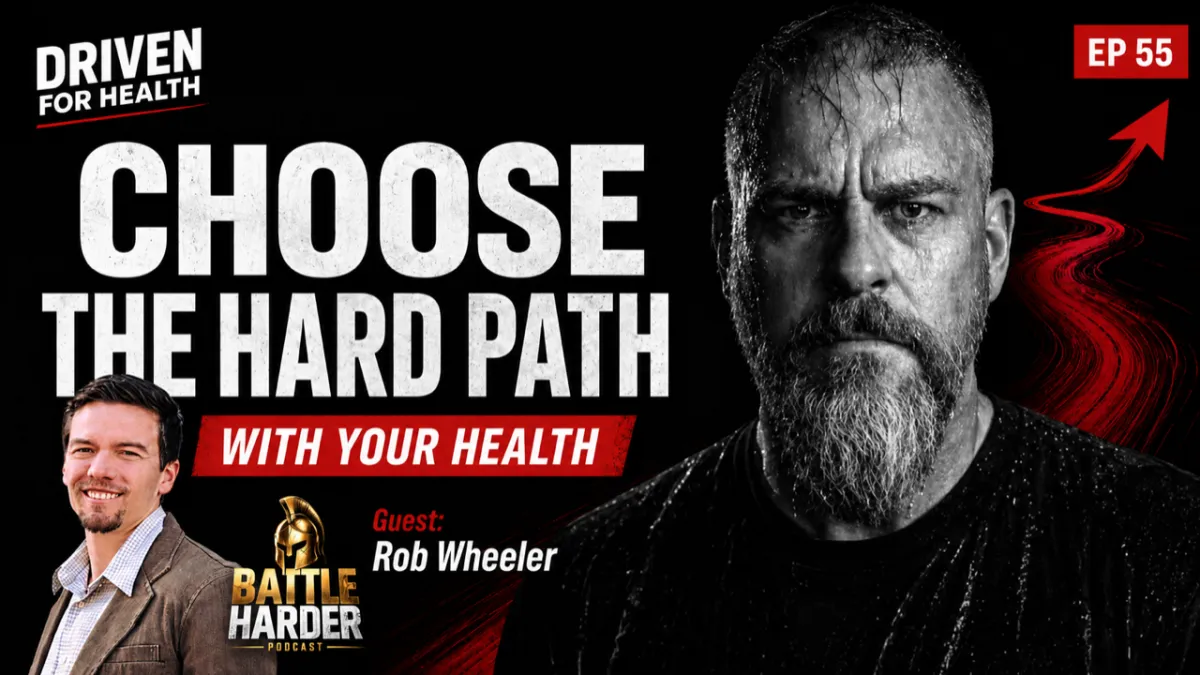
Both Paths Are Hard: How Busy Men Pick the One Worth It
Most men over 40 keep telling themselves they will get back on track once work calms down. Work does not calm down. In episode 55 Coach Brian and guest Rob Wheeler lay out the two hard paths every man is choosing between and the small moves that decide which one he walks.
Every path has a cost. Coach Rob Wheeler joins Coach Brian to work through why the hard of training and eating well beats the hard of surgery and low energy. This one is for the driven man who keeps waiting on a calmer season that never arrives.
Both Paths Are Hard
Rob Wheeler runs a coaching practice called Battle Harder. His framing on this episode is blunt. Every man is already walking a hard path.
One version of hard means eating well and training and building your mind. The other version means surgery and sickness and feeling awful most days. Both cost you something. Only one pays you back.
The idea traces to Navy SEAL Jocko Willink and gets credited to him on air. What the two coaches add is the health version of it. A man who thinks he is avoiding hard work by putting his body off is not avoiding anything. He is signing up for the other bill.
Waiting Is Not a Plan
Ask a man why he has not started and you get an answer about timing. Rob hears it on repeat. It is not the right time. Work is heavy. Next quarter will be calmer.
He calls that a copout and says the clock is not waiting for a better season. Rob names three pillars in his work, and a man who is stuck is usually missing one of them or two of them or all three.
Brian points to a book he reads to his kids at night. Dr. Seuss wrote about a place where people sit and wait for something to happen. Brian calls it the worst place a man can live.
Rob's line on it: "Action is the key to motivation, action is the key to willpower, because I always say those are two knuckleheads that'll never show up when you need them the most."
Start With the Body
Rob lists his pillars in a deliberate order: "fitness, mindset, discipline." Fitness sits first for a reason. In the way he uses the word, it covers how a man eats, how he speaks to himself, how he handles his family and his faith, and the physical work on top of that.
Brian agrees this is the lowest hanging fruit. Move the body first and the rest follows. A walk counts. A class counts. A hike counts.
The point is not the calories burned in week one. The point is that a man does the thing he said he would do. That is where self trust gets rebuilt, and self trust is what carries him into food and sleep and everything after.
Micro Adjustments Beat Grand Plans
Both coaches land on the same phrase for the fix. Micro adjustments.
Rob's food example is small enough to sound like nothing. A man eating fast food three times a week cuts it to two times a week. Rob says a month of that produces a change the man can see for himself. Most of the problem, in his read, is overconsumption and never being taught how to eat.
Brian runs the same play on daily habits. Can you walk more than you did last week. Can you drink more water than you did last week. Can you sleep ten more minutes than you did last week.
Brian also names why the big plan fails. He used to write out 12-week programs for people. Seven days in, life happened, and the program died on the page. The fix was to stop handing men a perfect plan and start finding the one obstacle in front of them.
Rob picks the activity with one question. What can you see yourself doing that you will enjoy. He lifts heavy because he likes it. Another man swims or bikes or walks. The activity has to stop being a chore or it will not survive a busy month.
The Part Most Men Skip
Brian raises something he sees in men in their 40s and 50s. They are doing life alone. No brother to call. Nobody who knows what the week cost them. The load gets buried in food or alcohol or whatever else is close at hand.
Rob's answer is a small circle rather than a crowd. Two men. Three men. He says coaches need coaches, and he describes calling a longtime friend on a hard day and getting a call back that afternoon.
He keeps it practical too. When a friend hit a rough season, Rob dropped a meal at the man's door so there was one thing he did not have to think about. Rob's read on the whole thing is plain. Sometimes the entire intervention is a text that says are you good.
Brian goes further on air and asks listeners to pause the episode and send that text before they forget.
Reframe Before You React
Rob names one tool by name. Reframing.
He catches the trigger, pauses, and asks whether the thing in front of him is worth the reaction. He is direct that this took work and that the pause is the part that changed his days.
Brian gives the version a man can use on a Tuesday. Trade I have to go to the gym for I get to go to the gym. Trade I have to get home and make dinner for I get to eat with my family. Same calendar. Different posture.
Brian's other line here is one he repeats with clients. Control what you can and do not worry about what you cannot. When work and family and everything else pile on at once, that sentence is the difference between a hard week and a lost month.
What To Do This Week
- Write down the two hard paths in front of you and what each one costs you in five years.
- Pick one activity you would enjoy and put it on the calendar three times this week.
- Make one food swap. One fewer fast food meal this week is enough to start.
- Text one man today and ask if he is good.
- Add ten more minutes of sleep, one more walk, and one more glass of water than last week.
- Catch one trigger this week and take the pause before you answer.
- Email Coach Brian at [email protected] and tell him which hard you are choosing.
More From Driven For Health
- Episode 54 covers why week three is where a fresh start falls apart.
- Episode 63 is a live coaching call on the connection men are missing in their 40s.
- Episode 73 covers men who hide what they are going through.
- Episode 53 tells the story of a client who lost 38 pounds in the 100 days.
Start Here
If you want a smaller first step, take the free plan at thecalltorise.com/lose3lbsin3days. It is a three day reset built for men with full calendars.
The Call To Rise is a 100-day Fat Loss Challenge designed for driven men ready to get back to a healthy body, boost their energy, and lead as a powerful man.
If you are struggling with some form of chronic illness such as high blood pressure, cholesterol or even Type 2 Diabetes - this program is designed for you too.
Through a proven system of strength training, personalized nutrition, and real accountability, most men lose 20 plus pounds and rebuild the confidence that comes with it and even improve chronic illness issues. It's more than a fitness program, it's a body transformation experience with a Brotherhood of like-minded men committed to showing up, leveling up, and leading in a body they are excited about.
This is your wake-up call to rise.
www.thecalltorise.com
Frequently Asked Questions
What does choosing your hard mean for your health?
Both paths in front of a man cost him something. Eating well and training is hard. Surgery and low energy and feeling awful is also hard. On episode 55 Coach Rob Wheeler frames it as a choice about which hard you carry.
Who is Rob Wheeler?
Rob Wheeler is the founder of Battle Harder and the host of the Battle Harder Podcast. He created a coaching framework called Operation Relentless for people rebuilding after a career change or a business loss or a personal setback.
Why does waiting keep men stuck?
Waiting hands the decision to a season that never arrives. Rob calls the not the right time answer a copout. Action comes first and clarity follows it.
What is a micro adjustment?
A micro adjustment is the smallest change you can hold on to. Cutting fast food from three meals a week to two is one. Walking more than you walked last week is another.
Why start with fitness instead of food?
Moving your body is the easiest place to prove to yourself that you follow through. Coach Brian says that proof is what carries a man into food and sleep and the rest of the plan.
Do men over 40 need other men to get healthy?
Rob says a circle of two or three men is enough. Men who train with a friend keep going on the days they do not feel like going.
What is reframing and how do you use it?
Reframing is changing the words you put on the same situation. Trade I have to go to the gym for I get to go to the gym, and take the pause before you react when something sets you off.
What is the Call To Rise program?
The Call To Rise is a 100-day fat loss challenge built around strength training, personalized nutrition, and real accountability. Most men lose 20 plus pounds and rebuild the confidence that comes with it.