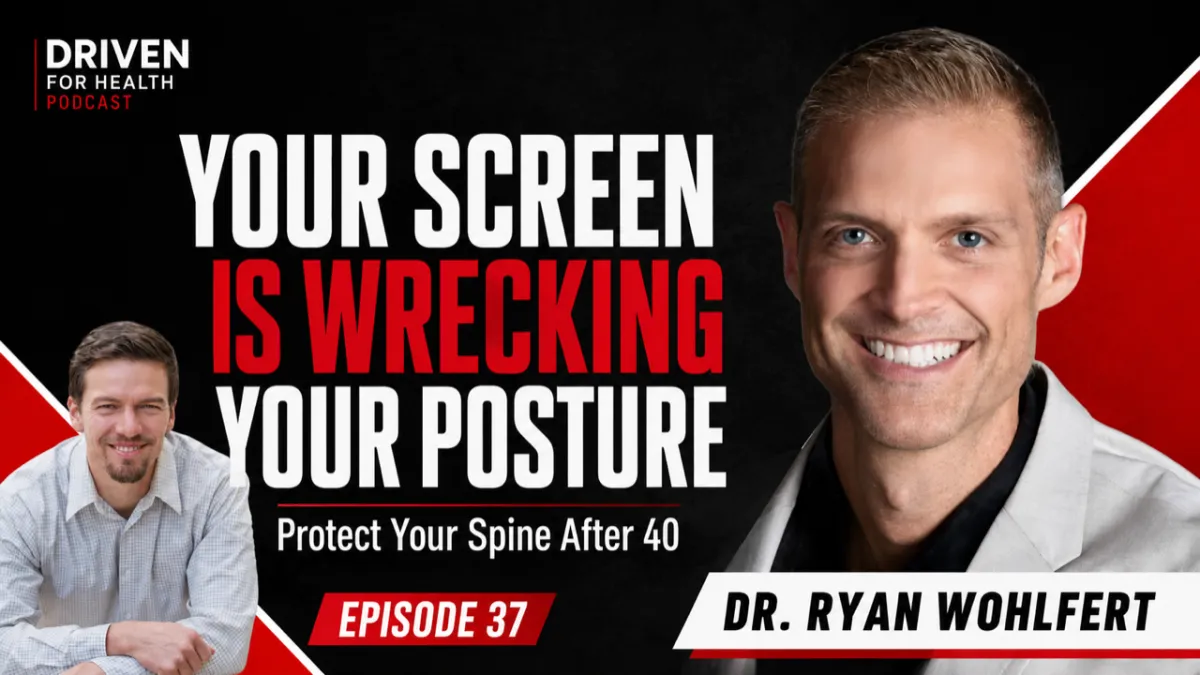
How Poor Posture Is Destroying Your Spine After 40 | Dr. Ryan Wohlfert | Driven For Health
If you sit for several hours a day and your neck or upper back tightens by mid-afternoon, your spine may be under more stress than you realize. This episode with spine specialist Dr. Ryan Wohlfert covers the research behind disc degeneration, the four-step EATN protocol for correcting posture, and two free resources Dr. Wohlfert offers men who want to take action today. Coach Brian and Dr. Wohlfert also discuss how posture connects to mood, energy, and long-term cardiovascular health.
Summary: Spine specialist Dr. Ryan Wohlfert joins Coach Brian on Driven For Health to explain why spinal degeneration begins decades before pain appears, what forward head posture does to the nervous system, and how men can assess and correct their own alignment at home. Research shows that nearly 40% of people in their 20s already show signs of disc degeneration, and that number climbs to 80% by age 50. Dr. Wohlfert shares his four-part EATN protocol for addressing the damage through corrective exercise, lifestyle adjustments, spinal traction, and nutrition.
By Age 20, Your Spine May Already Be Breaking Down
Most men discover their spine when something goes wrong. A headache that won't resolve for days. A shoulder that locks on a Monday morning. By the time those symptoms appear, the damage behind them has often been building for years.
Spine specialist Dr. Ryan Wohlfert has spent more than 25 years helping patients correct spinal dysfunction before it turns into chronic pain. He is a Certified Chiropractic BioPhysics physician, a Certified Chiropractic Sports Physician, and a Certified Mindset Specialist. He has worked with thousands of patients and helped them improve alignment, reduce chronic pain, and protect their long-term function. When he sat down with Coach Brian on Driven For Health, he opened with a statistic that reframes how most men think about their spine.
By age 20, nearly 40% of people already show physical signs of disc degeneration on imaging. By age 50, that number reaches 80%.
Disc degeneration means the cartilage between the vertebrae is breaking down. Cartilage cushions the joints and creates the space that allows nerves to exit the spine. As that space narrows, nerve signals get compressed. Pain may follow, or it may not. Dr. Wohlfert describes the absence of pain as a design feature, not proof that everything is fine. The body tolerates a certain amount of dysfunction before the brain decides the damage has become too significant to ignore.
By that point, a lot of degeneration has already occurred.
Listen to Episode 37 with Dr. Ryan Wohlfert
Your Posture Reveals the State of Your Nervous System
The common assumption is that tight muscles cause postural problems. Dr. Wohlfert turns that around. Muscles react to the spine, not the other way around. When the spine aligns properly with gravity, the muscles attached to it work efficiently. When alignment breaks down, those muscles compensate. The knots, the stiffness, and the chronic tension in the upper back are signals from the spine, not the source of the problem.
This connection matters for the nervous system in a specific way. The spinal cord runs inside the spine and carries signals between the brain and the rest of the body. The spine has three natural balanced curves: one in the neck, one in the mid-back, and one in the low back. When those curves are intact, the cord stays relaxed and signals flow freely. When posture collapses into a forward-rounded position, the spinal cord stretches under tension. That stretch disrupts signaling throughout the body.
The consequences extend beyond stiffness. Research cited by Dr. Wohlfert shows that poor posture decreases a person's overall outlook on life and worsens mood. Studies also link the forward-rounded posture to a significantly increased risk of death from heart disease and reduced pulmonary function. The mechanism is simple to demonstrate. Slouch down and take a deep breath. Then sit up straight and take another. The difference in lung capacity is immediate and unmistakable.
Confidence also changes with posture. Sitting tall activates the muscles needed for upright posture and changes how men carry themselves in conversation, at a table, and on camera. This is not a theory. Studies on posture and language show that slumped individuals use more negative words and report lower confidence than those seated upright.
The Weight Your Neck Carries Every Hour
The average head weighs 10 to 12 pounds. That weight is well-supported when the head sits directly over the shoulders. For every inch the head moves forward of neutral, the spine absorbs an additional 10 pounds of effective load.
Dr. Wohlfert measures forward head displacement on X-rays in millimeters. A displacement of 25 millimeters (roughly one inch) means the neck muscles are carrying the load of a 20-pound head, all day without rest. His patients typically present with one to two inches of forward displacement. That means many men walking through his door carry the equivalent of a 30- to 40-pound head on a structure designed for 10 to 12 pounds.
Screen use drives this process. Holding a phone at hip level bends the neck forward. Staring at a monitor below eye line does the same. Each session feels brief. The cumulative effect over years is not. The spine breaks down under chronic strain the same way any structure degrades under repeated load. One heavy event is not the cause. Thousands of ordinary sessions in a poor position are.
The confusion for most men is that the pain arrives late. One morning they bend to pick something up and cannot straighten. They blame that movement. Dr. Wohlfert points to the years of chronic positioning that had already weakened the structure.
How to Assess Your Own Alignment at Home
Dr. Wohlfert walks through two checks that require nothing beyond a mirror or a phone.
Front-view check. Stand facing a mirror with feet shoulder-width apart. Confirm that your nose, the center of your chest, your belly button, and your pubic bone form a single straight vertical line. Check the gap between each arm and the outside of each hip. A wider gap on one side indicates the trunk has shifted laterally.
Side-view check. Take a photo from the side. Your ear, shoulder, hip, and ankle should all stack in a vertical line. For a second test, stand with your heels 2 to 4 inches from a wall. Your hips, mid-back, and head should all contact the wall without effort. A head that needs pressing backward to reach the wall indicates that forward head posture has taken hold.
Neither check replaces a standing spinal X-ray. Both give a clear enough starting point to know whether to take the issue seriously.
What Three Types of Stress Do to the Spine Over Time
Dr. Wohlfert groups the stressors that break the spine down into three categories: physical, chemical, and mental.
Physical stress includes sustained poor positioning (looking at a screen below eye level, sleeping on too many pillows, driving in a hunched position) and acute events like falls, accidents, and neck tweaks. The acute events get the most attention. The sustained positional stress does the most damage over time.
Chemical stress comes from what enters the body. Inflammatory food choices add load to joints that are already under mechanical strain. Men managing neck pain with ibuprofen and NSAIDs are addressing symptoms rather than the cause. Anti-inflammatory food choices work on the same biological system, with fewer long-term side effects.
Mental and emotional stress changes physical posture. Under sustained pressure, the body tightens and collapses forward, feeding the mechanical breakdown loop. Men who carry heavy mental loads as providers, business owners, and fathers often hold that stress in the same places spinal degeneration attacks. Movement, deep breathing, and time outdoors break that cycle before it compounds.
The EATN Protocol: Four Steps for Correcting and Protecting Your Spine
Dr. Wohlfert uses a four-part framework adapted from Chiropractic BioPhysics. The letters stand for Exercise, Adjust your lifestyle, Traction, and Nutrition.
E: Exercise. This is corrective postural work, not general cardio. Dr. Wohlfert's recommended starting point is thoracic extension. Sit upright and clasp both hands behind your head. Pull your elbows back, lift your chest, and squeeze your shoulder blades together. Hold the position for 5 to 10 seconds. Perform this every 20 to 30 minutes at a desk. The movement stretches the chest, activates the mid-back muscles, and increases blood flow to the neck musculature. Rotation can be added, as long as the spine stays tall throughout.
A: Adjust your lifestyle. This covers the small biomechanical decisions that add up over a full day. Hold your phone at chin to chest level. For every inch the head drops toward a screen, 10 more pounds load onto the neck. When bending to a low surface, hinge from the hips rather than rounding the back. These movements happen dozens of times per day and over years, they accelerate the same degeneration the statistics describe.
T: Traction. Dr. Wohlfert considers this the most critical piece of the protocol. Lay-down spinal remodeling devices reshape the ligaments of the spine over time. The principle mirrors orthodontic treatment. Braces hold teeth in a corrected position long enough for the surrounding tissue to adapt and hold the change. Spinal traction devices do the same for spinal ligaments. One firm note from Dr. Wohlfert: do not purchase a traction device from an online retailer without professional guidance first. These tools work correctly only when calibrated to a known starting position. Without that information, the wrong device or angle can worsen the problem rather than correct it.
N: Nutrition. Food is chemistry applied to the body. Anti-inflammatory food choices reduce the chemical stress load on the joints. Dr. Wohlfert's practical starting point: use double the vegetables versus fruit in a smoothie. Simple, low-cost, and effective at reducing dietary inflammation without overhauling an entire meal plan at once.
Two Free Resources from Dr. Wohlfert
Dr. Wohlfert makes two resources available for men who want to go further without scheduling a clinic visit.
The Spinal Hygiene Mini Class is a free download at drwohlfert.com/spinalhygiene. It covers the full EATN method, including hydration strategy, corrective exercises with demonstrations, and guidance on how to use traction tools at home.
The Virtual House Call at drwohlfert.com/house-call is a one-on-one Zoom session where Dr. Wohlfert reviews posture, discusses specific symptoms, and gives individualized corrective recommendations. No travel required.
Take the Next Step
Direct CTA: The Call To Rise
Spinal dysfunction does not exist in isolation. It shows up alongside fatigue, weight gain, poor sleep, and the slow erosion of the physical confidence that men over 40 feel when their bodies stop keeping pace with their work.
The Call To Rise is a 100-day group coaching experience designed for men 40 to 60 who are ready to rebuild the physical foundation their life runs on. The approach: find the real reason fat loss stopped, build a food and training plan around a 47-year-old body, and run it 100 days alongside other men doing the same.
12 men have completed the 100 days. They averaged 25 or more pounds lost. The guarantee is clear: lose 20 or more pounds in 100 days, or Brian keeps working with you until you do.
Learn more and apply at thecalltorise.com.
Health Hot Seat
The Health Hot Seat is a free live group session where Coach Brian takes real questions from men over 40 and works through them on the spot. If this episode raised a question specific to your situation, this is the place to get a direct answer with no pitch attached.
Find the next session at brianparana.com.
Frequently Asked Questions
What percentage of people have disc degeneration by age 50?
According to Dr. Ryan Wohlfert, 80% of people show signs of disc degeneration on imaging by age 50. The breakdown starts much earlier. Nearly 40% of people in their 20s already show physical signs of degeneration.
What causes forward head posture in men who sit at desks?
Forward head posture builds from sustained positions that push the head in front of the shoulders. Looking at a monitor below eye level, holding a phone at hip height, and sleeping with too many pillows all move the head forward over time. The damage accumulates slowly, which is why it often goes unnoticed until pain arrives.
How does poor posture affect energy and mood?
When the spine rounds forward, the spinal cord stretches under tension. That stretch reduces the free flow of nerve signals between the brain and the body. Research cited by Dr. Wohlfert shows that this positional stress worsens mood and decreases a person's overall outlook on life.
How can I check my posture at home without equipment?
Stand facing a mirror and confirm that your nose, chest, belly button, and pubic bone form a straight vertical line. Then stand sideways with your heels 2 to 4 inches from a wall. Your hips, mid-back, and head should all comfortably touch the wall. A head that requires pressing back to reach the wall indicates that forward head posture has developed.
What is the EATN protocol for spine health?
EATN stands for Exercise, Adjust your lifestyle, Traction, and Nutrition. Exercise means corrective postural movements like thoracic extension rather than general cardio. Adjust your lifestyle means changing how you hold your phone, bend, and sit throughout the day. Traction refers to lay-down devices that reshape the spine's ligaments over time. Nutrition means choosing anti-inflammatory foods to reduce chemical stress on the joints.
What corrective exercise does Dr. Wohlfert recommend for desk workers?
Dr. Wohlfert recommends thoracic extension every 20 to 30 minutes while seated. Clasp both hands behind your head, pull your elbows back, lift your chest, and squeeze your shoulder blades together. Hold for 5 to 10 seconds. This movement opens the chest, activates the mid-back muscles, and increases blood flow to the neck musculature.
Is spinal traction safe to do at home?
Lay-down spinal remodeling devices can be effective when used with professional guidance. Dr. Wohlfert warns against purchasing one from an online retailer without knowing the starting position of your spine first. Traction works correctly only when calibrated to a specific structural starting point. Without that information, the wrong device or angle can worsen the problem.
Can poor posture increase the risk of heart disease?
Dr. Wohlfert references research showing that a chronically forward-rounded posture significantly increases the risk of death from heart disease and reduces pulmonary function. The mechanism involves compression on the lungs and reduced breathing capacity. A simple demonstration: slouch forward and take a deep breath, then sit tall and take another. The difference in capacity is immediate.