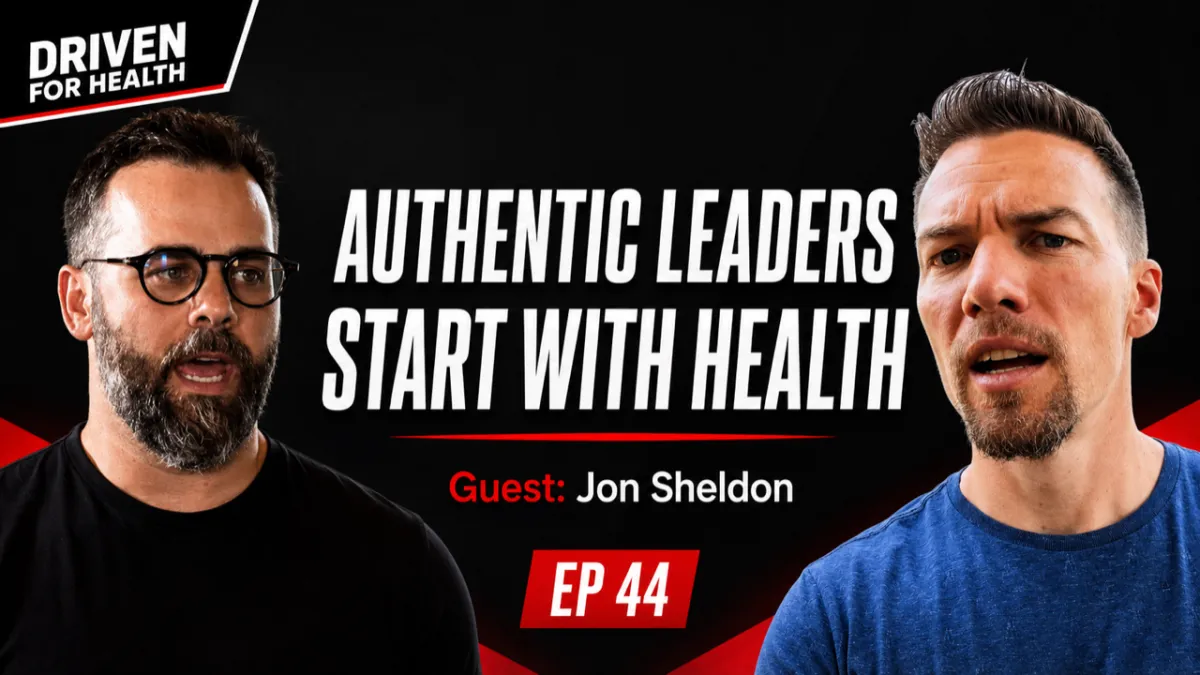
The Weight Driven Men Carry And Never Put Down
A man can announce that the whole house is getting healthy and change nothing about himself, and everybody in the room knows it. Your own health is the only part of your leadership that cannot be delivered as a speech. Episode 44 works through why that load builds in the first place, and the questions Jon Sheldon uses to find where it went.
Jon Sheldon is a prior Marine infantry squad leader who deployed to Iraq in the early 2000s. He spent the better part of 15 years in high level financial planning and now runs a coaching practice for leaders and teams. In episode 44 of Driven For Health he sits down with Coach Brian Parana to work out why so many men in their 40s and 50s look successful on paper and feel worn down underneath it. Listen to Episode 44 for the full conversation.
The Rock You Keep Putting In Your Pack
Brian opened by asking what one big takeaway Jon wanted a listener to have. Jon answered with the image the rest of the episode runs on.
"You don't have to just figure it out or just take care of it. You don't need to pick up that extra weight or that rock and put it in your pack."
He built it out later. Picture a ruck walk with a pack on your back. Something lands on you at work or at home and you say the four words, and then you reach down, take a rock off the path and drop it in.
"It's every time you say that, all you're doing is taking and picking up a rock on the path and just putting it in your pack, saying, 'I'll take care of it.' And then something else happens in your life, your family, your business, and you're like, 'I'll take care of it.'"
Jon has spent his working life around men. The Marines first, then financial planning. He described the room he has always been in as high value, high driven men, and he said the tell he watches for is the phrase itself.
"They'll say I'll take care of it. I'll figure it out. And that's their answer for everything."
Nobody hands you the rock. You choose it, and for a driven man it is the fastest answer available. So the pack fills over years and never gets emptied, because emptying it would mean telling somebody the load is heavy.
"There gets a point in time where you just can't take the next step."
The Last Rep With No Spotter
The second image in the episode was built by both men on air, and it is worth marking who put in which half.
Jon was mid-thought about the pack getting too heavy when Brian supplied the gym version of it out of two decades of coaching lifters.
"You don't hit the last rep until you're halfway through the last rep."
Brian filled in the feeling. "How many times that happened when you're working out where you're like oh I got this. I got this. I got this. And then all of a sudden you're like halfway through number 10 you're like oh I don't have this."
Jon took it straight into a man's life.
"And that's what happens in what I witnessed with men in life is by the time they realize that it's like you're there, you don't have enough, you can't push it up anymore."
Then he asked the question that does the real work in this episode.
"And if you don't have a spotter, what do you do? And that's why that's one of the reasons why I think men's mental health is such a big thing to me is because I've been witnessing that for so long now."
Jon put the range on it too. Chief executives at the top, down to a man a year out of college. "It's just when is that last rep hit and are you prepared for it?"
Brian answered that from his own practice. For the men he coaches, the last rep is a blood panel that comes back wrong and a doctor who says lose weight and sends him home. Or a photograph. Or clothes that stopped fitting a while ago. Or a wife who has stopped reaching for him. Or being out of breath keeping up with his own kids.
Most driven men have built an entire life with no spotter in it.
Authentic Leadership Is The Version You Live
Brian asked Jon what authentic leadership means to him. Jon started by naming what it is not. A Marine Corps leadership system he could no longer recite from memory, and two well known leadership authors whose names everybody quotes.
"Those aren't mine."
His instruction was to borrow the material and then stop short of repeating it.
"Draw from the past, draw from other examples, but take the time to not just regurgitate what you heard."
Then the test, which is one sentence long.
"Because if it's not authentic to you, you just won't do it."
He put it next to core values. He builds core values with families as well as businesses, and his view is that a value nobody is held to is worse than no value at all.
"If you're not holding to them, then why even have them?"
The fix is not to drop the values. The fix is to change them to ones you will hold.
Brian then asked where men lead well and where they fall down. Jon gave one answer for both halves.
"I find that men who are doing a good job of being leaders are leading by example."
The ones falling short do a lot of talking and little practising of it.
Why This Lands On Your Body First
Brian took Jon's point straight into the house, because this is the failure he watches men run at home.
"I'll work with a man and then he wants to influence his family. You have to lead by doing. You can't come in and just all of a sudden, well, we got to clean out the fridge and the pantry and we got to start walking together every night and we're off screens at this time."
Jon's answer to that was two words. "Good luck, man."
Brian finished the thought. "You're burning bridges here real quick. But if you lead and they see change, that magnifies the effort and the intensity and the focus."
The version that works is slower. You change first. They watch it happen over weeks. It becomes credible because it is standing in front of them at dinner, and then the pull toward it is theirs.
Which means your own health stops being a private project. It is the one part of your leadership that cannot be delivered as a speech, because everybody in your house can see whether you are doing it.
That is also why workouts are usually the first thing to go when a man loses his footing. Training is the promise with no audience and no client attached. It is the easiest one to drop without anyone noticing, and that makes it the most honest signal you have about the rest of it.
Jon's Four Part Blueprint
Brian asked for the pillars. Jon named four. Purpose, vision, environment, and motivation.
Purpose. He starts here. He borrows in part from ikigai, which he described as an ancient Japanese word that roughly translates to your reason for being. The four questions in it are what you are good at, what you like to do, what you can be paid for, and what the world needs. Jon leans on the first two and says the same question runs on a man's personal life, not only his career.
The origin of the pillar is worth knowing, because he found it in himself first. He watched men come out of the service and land on the other side with nothing to aim at.
"You join the military and you have this deep purpose. One that you learn to die for."
Then it ends.
"And then you get out and you go to college and then what's your purpose?"
"So that's one of the first triggers for me was I need to find new purpose."
He says the pattern turned out to be far wider than that one group, and the model was never built only for them.
Vision. "Your vision is where are you going? You figure out who you are, your purpose in life. Now where are you going with that? And that gives you that drive."
Environment. "The third one is your environment or ecosystem. Who do you surround yourself with? What people, places, tools, things do you thrive in?" For one man that is his family. For a single man it might be his group of friends. For another it is his wife and nobody else.
This is the pillar Jon says most men are getting wrong, and the failure he names is specific. It is not that they do not know their environment. It is that they never get into it often enough for it to count.
"Most people are really screwing up that they never put themselves in enough positions to be in that environment long term."
Motivation. Jon names motivation as the fourth pillar and lists it again when he closes out the episode. The conversation never doubles back to unpack it the way it unpacks the first three, so treat it here as named rather than taught.
Now run the first three against your health. A man with no purpose has no reason to train. A man with no vision has no destination to train toward. A man in the wrong environment is surrounded by people who make the wrong thing easy. Those three questions are a decent diagnostic for why the gym stopped happening.
Environment Is The Lever Most Men Ignore
Environment got the most airtime in the episode, and both men brought a version of it.
Jon's is a standing guy night, a couple of Thursdays a month. He told a story about a stretch when travel and work crowded it out and he did not notice what was missing.
"She literally told me one day she's like, 'You need to go hang out with your friends tonight cuz you're in a weird headspace.' And she's right. She was totally right. I didn't even realize at the time of like that's what I was actually missing."
That is what environment does. It runs in the background, and you feel its absence before you can name it.
Brian's version stacks two things men usually keep separate. Training and friendship. His men's group meets in the barn behind his house a couple of days a week, and there is a whiteboard on the wall that he turned the camera toward mid-episode.
"All those letters, numbers and letters are dates and it tells us what we did. So, I have the date. I've got initials for who was with me. And then I have the body part or exercise stuff that we did."
One set of initials on that board belongs to Chris. Brian met him at a father-daughter dance, went for coffee, and asked him to come and train.
"He's overweight. He's overstressed. He was drinking a lot. He was just disconnected."
An hour of work a couple of days a week became the outlet. Brian's read on him now:
"He's significantly better mentally, emotionally, physically as a result of coming over here."
They put movies on while they lift. There is nothing sophisticated about any of it.
The wider point belongs to Jon. Doing something hard alongside another man builds a bond that talking never does.
"Some of the deepest bonds that I've ever made have been workout buddies or hunting buddies."
"You do hard stuff together."
He learned that in the military and kept it afterwards. He worked on a farm at 15, then for a landscaper, then ran his own landscape company before he moved into finance, and he still builds a patio a year for family and friends because of how it feels to finish one.
"How gratifying it was to do something really hard cuz it was hard."
Not much in a modern week is genuinely hard. Convenience took away most of the things that used to produce meaning as a byproduct. Your training can be the hard thing, and it is the easiest one to put on a calendar with another man.
Authenticity Is Manly
Jon said a thing on air that he knows lands oddly on some men.
"Like I say, I love you to every guy I get off the phone with."
He said his wife used to find it odd. His own view of it is short.
"And that's not me being a weak man."
Brian agreed and gave it a name.
"I think we need to dive into authenticity is manly. Like being that person of your sense self that's confidence."
For Brian the hallmark of a man is being confident in who you are, and he finished the point plainly.
"And if that's a guy that says I love you to his friends, be that dude."
Brian said on air that he has not felt love like that from his own father in about two decades. He left it at that. What he took from it was a decision about his own four kids, to be present and engaged with them while they are still at home.
It reaches small places too. He coaches his kids on screens the way he coaches clients on food.
"Are you living life 10 seconds at a time? Because if you do, you'll wake up 10 years from now wondering what happened."
"Can we do something other with that screen time that you're doing? Listen to a podcast. Find an interest area. Watch a movie."
"My kids get a dad, a loving dad, but also a coach."
The Man Who Sold The Mustang
This story is Brian's, and it is the one he uses to show what alignment does to a body.
Drake was making $250k a year. Fast cars, the high life, able to do more or less whatever he wanted. On paper he was the man everyone in the room wanted to be.
The career was stifling him and his body was keeping the score. His blood pressure was high enough that his doctor wanted to medicate him immediately.
"You're a walking heart attack, Drake, is what she said. And he said, 'Give me six months.'"
What happened next was not primarily a nutrition intervention. It was a man being asked the right questions and then being held to the answers he gave.
"I allowed him to step toward authenticity, to step toward who he actually is."
He quit the job. He sold the car inside a weekend. He had been driving a Shelby GT Mustang and had reached a plain conclusion about it, which Brian quotes back in Drake's own words.
"Brian, I'm an F-150 guy. Why are you driving around in a Mustang, man?"
He called from the parking lot when he picked up the truck and sent photos of it. Then the rest of it arrived over the years that followed. He got engaged and married. He bought a house. He ended up earning more than he had before.
Notice the order of operations. The weight came off alongside the alignment, not instead of it. He stopped living a life that was not his, and his body followed the man.
The Signs A Man Is At His Limit
Brian asked what the signs look like, and whether there is a timing to them. Jon answered without hesitating.
"What I notice is guys end up getting quiet and disassociating."
He put that first because it is the one he sees most.
"I think that's the most common symptom that I personally see is you'll see dudes, they'll stop hanging out as much."
He was careful about the edge of his own expertise, and said so on air.
"I'm not even close to say that I know much or anything about being an expert in depression or anything like that, but it's just what I notice is is they start disassociating."
Brian added the word that hides all of it.
"Fine is I'm good. I'm fine. That's a common response that everyone says regardless of what actually is going on."
Fine is the word men use when the true answer is not available.
The Text Jon Sent The Next Day
This is the part of the episode Jon himself picked as the takeaway at the end, and he said he had not expected it to be the thing.
He was at a bar with the Thursday group. One man there is, by Jon's account, the biggest talker he has ever met, and a kind and generous one.
He started asking questions and braced for the usual flood. It did not come.
"And it was like these kind of like two or three-worded answers and you could just tell on his face that something is deeply like bothering him."
He asked in person once the others moved off.
"I said you all right man like everything good and even in that response you could tell everything was not okay, something was going on but he didn't feel comfortable talking about it."
Then he went home and did the thing most men do not do. The next day he sent a text.
"Hey, I wouldn't be doing a good job as a friend if I didn't check in on you. You definitely seem to off. Just want to let you know if you ever want to vent, talk, go out to coffee, whatever, outside of like the group stuff we do. I'm here for you, man. Just let me know."
The reply came back.
"Yeah, it's just been a lot going on. You're really, you know, you're a really good friend. Thanks for checking in on me. Yeah, everything's not okay, but you know, I might take you up on that in the future."
Nothing was solved by that message, and that is not the point of it. A man who was carrying it alone now knows there is one person he can hand it to.
What frustrates Jon is the other version of the same night, which is the far more common one. A man leaves the bar, everybody notices the same thing, and nobody checks on him.
"Everyone's like, 'Man, he's really off today.' Yeah, he is. Nobody says a word. Come on, let's be better than that."
He tied it back to the rock.
"That's what I mean by that rock. It's just like, oh, you're just supposed to be okay no matter what."
When Brian asked at the close what one thing he wanted a man to take away, Jon went back to the text rather than to either of his frameworks.
"Don't be afraid to be that guy in your friend group because everybody needs one of them. And it's not weakness, it's strength."
"If you want to do it, send them the text. Don't be like, I shouldn't. That's going to cross a line. No, send them a text. Are you okay?"
The Battle Plan
Jon runs a second framework alongside the blueprint, and he named it near the close.
"The other one is called the battle plan, which is a six stage decision model to help you make decisions quickly and accurately."
The six stages: clarity, condition, cost, align, act, adapt.
The two frameworks point at the same end, which Jon described earlier in the conversation as being a fully confident man or leader who makes decisions confidently and quickly. His argument is that the confidence and the speed feed each other.
"We know that that even builds even more confidence and confidence is key in this life."
Brian's own note on frameworks like these is that handing a man the model is the easy half.
"I find a lot of people that I work with already know what they should be doing, aren't doing it."
Run This On Yourself This Week
- Name one rock you picked up this month by saying you would take care of it. Decide whether it stays in the pack or gets handed to someone.
- Name your spotter. One man, by name, who would notice if you went quiet. If you cannot name one, that is the finding.
- Answer Jon's first three questions honestly. What is your purpose. Where are you going. What environment do you thrive in.
- Take the environment answer and put it on the calendar as a repeating event, because that is the pillar Jon says most men know and never schedule.
- Book one hard thing with another man this week. A lift, a long walk, a job at his house.
- Stop announcing changes to your family and make one yourself where they can see it. Let it run three weeks before you say a word about it.
- Think of the man who came to mind while you read Jon's story. Send him the text today.
More From Driven For Health
Jon Sheldon came back on the show later. Episode 59 of Driven For Health puts Coach Brian in the client chair and Jon runs him through the blueprint live, with nothing sent to him ahead of time. Episode 44 is the case for why your health is a leadership problem. Episode 59 is what happens when a coach lets somebody else ask him the questions.
Where To Go From Here
If your training has been the thing that disappeared first, start with something small enough that it survives a bad week. Lose 3 lbs in 3 Days is a free three day plan built for men with full calendars. Protein first meals, water, more steps, no calorie restriction and no extra workouts. Get it at thecalltorise.com/lose3lbsin3days.
If you want the whole thing handled for the next 100 days, the work runs in three steps. Find the real reason your fat loss stopped. Build your food and your training around a 47 year old body, not a 27 year old one. Run it 100 days alongside other men doing the same thing.
The guarantee is plain. Lose 20 plus pounds in the 100 days, or Coach Brian keeps working with you until you do.
The Call To Rise is a 100-day Fat Loss Challenge designed for driven men ready to get back to a healthy body, boost their energy, and lead as a powerful man.
If you are struggling with some form of chronic illness such as high blood pressure, cholesterol or even Type 2 Diabetes - this program is designed for you too.
Through a proven system of strength training, personalized nutrition, and real accountability, most men lose 20 plus pounds and rebuild the confidence that comes with it and even improve chronic illness issues. It's more than a fitness program, it's a body transformation experience with a Brotherhood of like-minded men committed to showing up, leveling up, and leading in a body they are excited about.
This is your wake-up call to rise.
www.thecalltorise.com
Frequently Asked Questions
What is episode 44 of Driven For Health about?
Coach Brian Parana talks with Jon Sheldon about authentic leadership and why a driven man's health is the first thing to break when his purpose gets blurry. It covers the load men carry, the warning signs of hitting a limit, and a four part blueprint of purpose, vision, environment, and motivation.
Who is Jon Sheldon?
Jon Sheldon is the guest on episode 44. He is a prior Marine infantry squad leader who deployed to Iraq in the early 2000s, spent the better part of 15 years in high level financial planning, and now runs a coaching practice for leaders and teams.
What is the rock in the pack analogy?
It is Jon Sheldon's picture of how men overload themselves. Every time a man says he will take care of it, he picks up a rock off the path and drops it in his pack. Nothing ever comes out. In his words, there gets a point in time where you cannot take the next step.
Why does authentic leadership start with your own health?
Your health is the one part of your leadership you cannot deliver as a speech. Your family and your team can see whether you are doing it, which is why Jon Sheldon names leading by example as the answer to both halves of the question.
What are the four pillars of Jon Sheldon's authentic blueprint?
Purpose, vision, environment, and motivation. Purpose is your reason for being, vision is where you are going with it, and environment is the people and places you thrive around. Jon names motivation as the fourth pillar, and the episode spends its time on the first three.
What are the signs a man is carrying too much?
Jon Sheldon says men get quiet and start disassociating, and they stop hanging out as much. Their answers shrink to two or three words, and when you ask them directly they say they are fine.
How do you check in on a friend who seems off?
Send a short text the next day saying you would not be doing a good job as a friend if you did not check in, that he seemed off, and that you are there if he wants to talk. That is what Jon Sheldon did, and he calls it strength rather than weakness.
What is the Call To Rise program?
The Call To Rise is a 100 day fat loss challenge for driven men over 40, built on strength training, personalized nutrition, and real accountability. Most men lose 20 plus pounds.