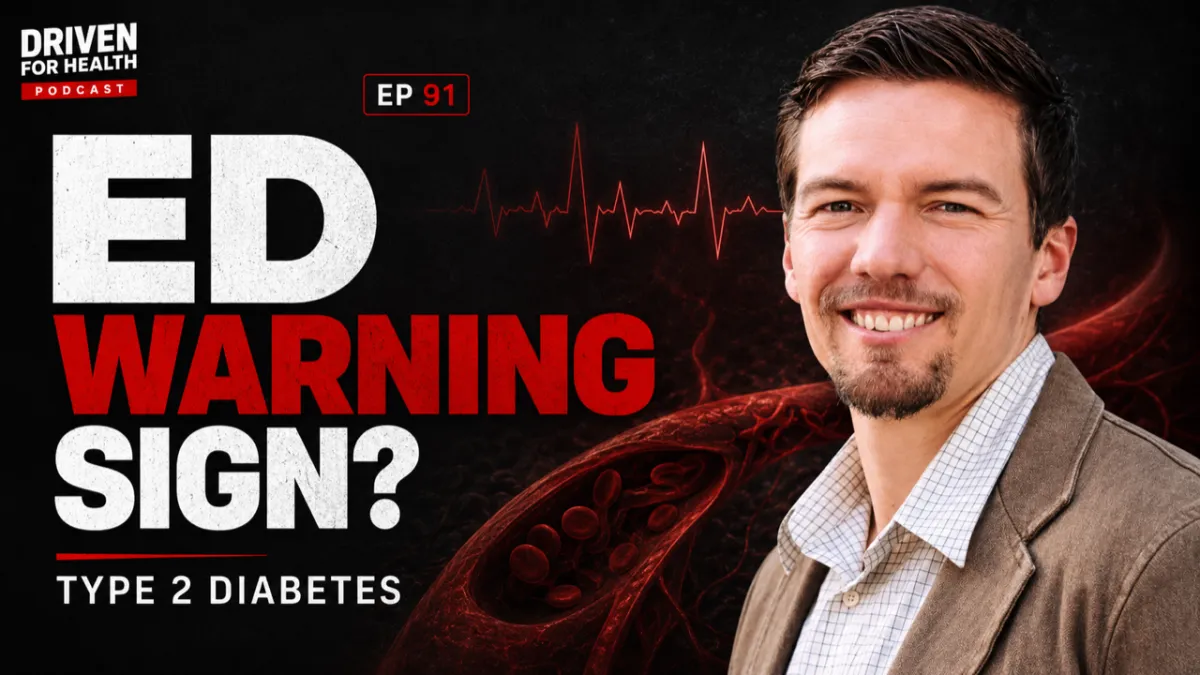
ED and Type 2 Diabetes: Why the Medication Works for Only Half of Men
The medication most men are privately counting on for erectile dysfunction works for about half the men with diabetes in their situation. The rest are left without answers. This episode gives you the full picture: three mechanisms, the medication truth, and five action steps tied to each one.
Between 50 and 75 percent of men with type 2 diabetes will develop erectile dysfunction. Most never bring it up with their doctor. In many of those men, the symptom shows up before the diabetes diagnosis.
This episode covers the three mechanisms driving it, why the standard medication works for only half the men who need it, and five action steps mapped directly to each mechanism. Listen to Episode 91 for the full conversation.
The Number That Changes Everything
Between 50 and 75 percent of men with type 2 diabetes will develop erectile dysfunction. That is the majority of men with this disease.
In many of those men, the symptom shows up before the A1C comes back elevated. Sometimes two to five years before a doctor says the word diabetes. For a significant number of men, this is not a consequence of the disease. It is the first sign the system is already breaking down.
Most men miss that signal because they do not know what it means.
Three Mechanisms, Not One
Most conversations on this topic treat it as one problem with one cause. That framing is why most men stay confused about what to do.
Three separate mechanisms drive erectile dysfunction in diabetic men. They can run independently or compound each other. Which one you are dealing with changes what recovery looks like.
Mechanism One: Blood Flow
When blood sugar stays elevated over months and years, it damages the inner lining of blood vessels. That lining produces nitric oxide, the compound that signals vessels to relax and open.
When the lining takes damage, nitric oxide production drops. Blood flow decreases throughout the body. The arteries involved in sexual function run one to two millimeters across. The arteries supplying the heart run three to four millimeters. The smallest vessels fail first.
A 2018 meta-analysis found that men with erectile dysfunction and no other known cardiac symptoms carry a 44 percent higher risk of a future cardiovascular event. The narrowest part of the system reveals a problem that runs through all of it.
Mechanism Two: Nerve Signal
An erection does not start with blood flow. It starts with a nerve signal.
High blood sugar damages autonomic nerve pathways over time. This is called autonomic neuropathy. It is more common in diabetic men than most people realize. It is also the reason the standard medication backup plan is far less reliable than most men assume.
Vascular function can start improving within weeks of lifestyle change. Nerve regeneration is measured in months to years, and only under sustained blood sugar control. Nerve damage compounds over time. The man who understands that has a reason to act now that the man thinking only about blood flow does not.
Mechanism Three: The Anxiety Loop
One failed or inconsistent episode creates performance anxiety. Performance anxiety fires the stress response. The stress response releases cortisol. Cortisol raises blood sugar. Higher blood sugar worsens both blood vessel function and nerve signaling.
In a man without metabolic dysfunction, this loop breaks on its own. In a man with insulin resistance or diabetes, the cortisol spike runs through his blood sugar and feeds both mechanisms already working against him.
The anxiety does not stay in his head. It moves through his biochemistry.
What Happens to Testosterone
Visceral fat contains an enzyme called aromatase. Visceral fat is the fat stored around your abdomen and organs. Aromatase converts testosterone into estrogen. The more visceral fat you carry, the more of your own testosterone gets converted before it reaches the tissue that needs it.
Research puts the waist circumference threshold at around 40 inches for most men. Above that number, aromatase activity is elevated enough to meaningfully suppress free testosterone. Below it, that conversion starts to slow. That is a direct hormonal lever available without a prescription.
Insulin resistance also disrupts a protein called SHBG. SHBG controls how much free testosterone circulates in your blood. When that balance is off, free testosterone drops even when total testosterone looks acceptable on paper. This is why men get labs back showing normal testosterone and still feel nothing like themselves.
The Sleep Condition Most Men Have Never Been Tested For
Research estimates 50 to 70 percent of men with type 2 diabetes have clinically significant sleep apnea. Most have never been told.
Testosterone production in men happens predominantly during deep sleep. If your airway keeps collapsing through the night, your body is not completing the repair cycles that restore hormonal balance overnight. Sleep apnea also drives cortisol elevation and worsens overnight glucose control.
It is one of the most treatable conditions in this picture. A sleep study takes one night. CPAP treatment feels awkward for the first two weeks and unremarkable after that. It has shown measurable testosterone improvement in men with both sleep apnea and low testosterone.
If you snore loudly, wake unrested regardless of hours slept, and crash hard in the afternoon, ask for a sleep study at your next appointment.
The Medication Truth
In the general population, PDE5 inhibitors work for roughly 80 to 85 percent of men who take them.
In men with diabetes-related erectile dysfunction, that number drops to approximately 50 to 60 percent.
These medications work by enhancing nitric oxide signaling and increasing blood flow. They address the vascular problem. When nerve damage is also present, the initiation signal is impaired regardless of how much blood flow improves. Better blood flow cannot fix a damaged nerve pathway.
The backup plan most men are privately counting on works for about half the men in their situation.
The Three-to-Five-Year Window
Researchers tracking men with erectile dysfunction and no other known cardiac symptoms found that a meaningful percentage experienced a cardiovascular event within three to five years when the underlying metabolic dysfunction was not addressed.
For most men, that is not an abstract future. It is before your youngest finishes high school. Before the business gets to where you are building toward.
This symptom is not predicting something that might happen in old age. It is a measurable signal about a window running right now.
The Conversation at Home
If you are married, your wife already knows something is different. She has not named it. You have not named it. In the absence of an explanation from you, she has filled that silence with her own.
Her explanation is almost certainly about herself.
One sentence removes most of that weight: "Something has been going on with my health that I am working on. It has nothing to do with you and I did not want you left trying to figure out what it was."
That names that something exists. It removes her from the equation as a cause. The silence is not neutral. It runs directly into the anxiety loop, raising cortisol and elevating blood sugar in ways no supplement or habit change will fix while it stays unspoken.
Five Steps, One for Each Mechanism
For blood flow: Walk after dinner tonight. Ten to fifteen minutes. Post-meal walking improves nitric oxide production and glucose disposal at the same time. The vascular mechanism responds fastest to lifestyle change. Start tonight.
For nerve regeneration: Get blood sugar under sustained control and keep it there. Nerve regeneration requires a consistent glucose environment over time. The 90-day average your A1C measures is the number that creates the biological conditions for nerve repair.
For the anxiety loop: Say something plain to your wife this week. Book the doctor appointment. Both actions reduce the cortisol load that feeds the loop through your blood sugar.
For testosterone: Get your waist under 40 inches with intention. Every pound of visceral fat lost from your midsection reduces aromatase activity. Every reduction shifts the hormonal environment.
For sleep and hormonal repair: Ask for a sleep study. If you snore, wake unrested, and crash in the afternoon, this single test may be the most important thing you do this year.
What to Expect at 30, 60, and 90 Days
At 30 days, walk after meals consistently and blood sugar trends should start moving. Fasting glucose numbers will begin improving. Morning erection frequency may show small improvements as nitric oxide production responds to regular movement. Expect direction. Dramatic change comes later.
By 60 days, when visceral fat is dropping and sleep is protected, free testosterone levels begin improving in many men. The waist measurement matters more than the scale at this stage. The anxiety loop begins to soften when physical progress is measurable and the doctor conversation has happened.
At 90 days, your A1C retest will tell you whether the sustained glucose control needed for nerve recovery is being established. Men who show a drop of 0.5 to 1.5 points at 90 days are building the biological environment that nerve regeneration requires.
The vascular mechanism responds fastest. The hormonal environment follows. The neurogenic pathway moves slowest and requires the most patience. All three are moving in the same direction when the habits are consistent.
Listen to Episode 91 of Driven For Health for the full conversation.
Frequently Asked Questions
How common is erectile dysfunction in men with type 2 diabetes?
Between 50 and 75 percent of men with type 2 diabetes will develop erectile dysfunction. In many of those men, the symptom shows up before the diabetes diagnosis, sometimes two to five years before the A1C comes back elevated.
What are the three mechanisms driving ED in diabetic men?
Three mechanisms drive this and can run independently or compound each other. The first is vascular damage: high blood sugar damages blood vessel linings and reduces blood flow. The second is nerve damage: elevated glucose damages the autonomic nerve pathways that initiate sexual function. The third is a performance anxiety loop that raises cortisol, which raises blood sugar and worsens both other mechanisms.
Why do ED medications work less often in men with diabetes?
PDE5 inhibitors work for roughly 80 to 85 percent of men in the general population. In men with diabetes-related ED, that number drops to approximately 50 to 60 percent. These medications address blood flow. When nerve damage is also present, improving blood flow alone is not enough because the nerve pathway driving the initiation signal is impaired.
What waist size affects testosterone in men with type 2 diabetes?
Research puts the threshold at around 40 inches for most men. Above that number, visceral fat produces elevated amounts of aromatase, an enzyme that converts testosterone into estrogen. Below 40 inches, that conversion begins to slow. Getting the waist under 40 inches is one of the most direct hormonal levers available without a prescription.
How does sleep apnea connect to type 2 diabetes and erectile dysfunction?
Research estimates 50 to 70 percent of men with type 2 diabetes have clinically significant sleep apnea. Sleep apnea interrupts deep sleep, where testosterone production happens. It also elevates cortisol and worsens overnight glucose control. CPAP treatment has shown measurable testosterone improvement in men with both conditions.
Can erectile dysfunction show up before a type 2 diabetes diagnosis?
Yes. In many men, erectile dysfunction appears before the A1C comes back elevated, sometimes two to five years before a doctor identifies the diabetes. The body's smallest blood vessels fail first. That damage shows up in sexual function before it is visible on standard lab tests.
What is the cardiovascular risk tied to this warning sign?
A 2018 meta-analysis found that men with erectile dysfunction and no other known cardiac symptoms carry a 44 percent higher risk of a future cardiovascular event. Researchers tracking these men found that a meaningful percentage experienced a cardiovascular event within three to five years when the underlying metabolic dysfunction was not addressed.
What should a man tell his doctor at his next appointment?
Use this sentence: "I have noticed some changes in sexual function and I want to make sure we are looking at the full cardiovascular and hormonal picture." Ask specifically for total testosterone, free testosterone, and SHBG. If you snore or wake unrested, ask for a sleep study as well.