Urgency and Patience: How Men Over 40 Restart Their Fitness
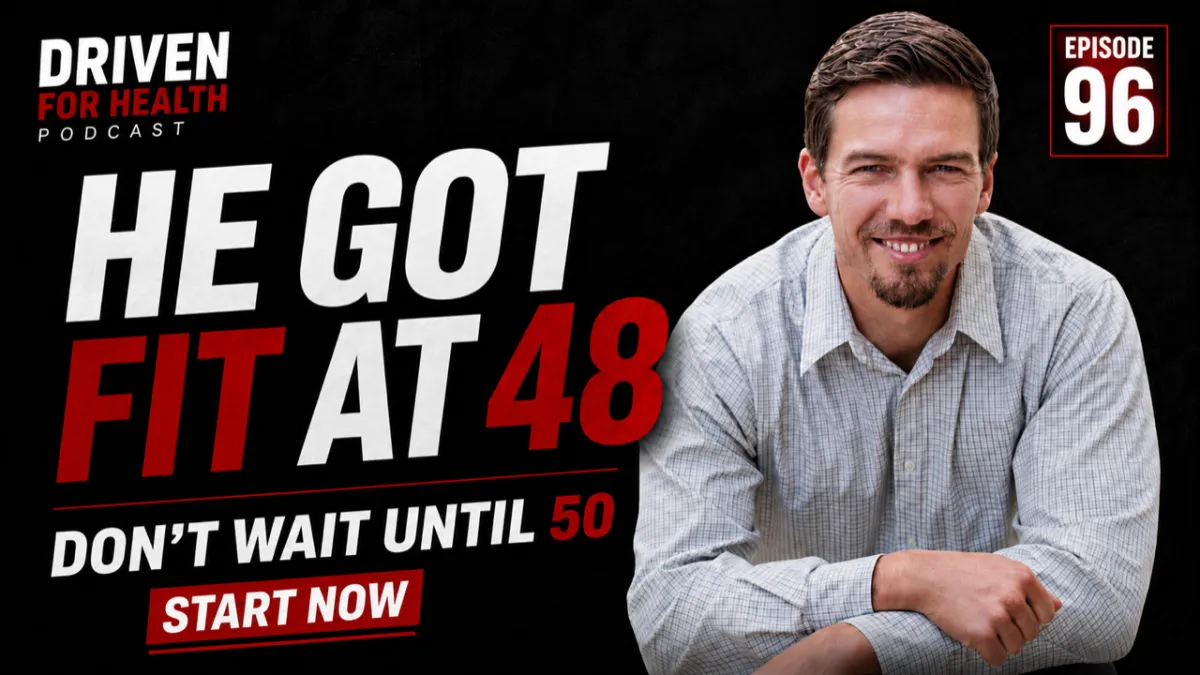
Most men wait for a bad doctor visit before they take their health seriously. Jeff Weiss never got one. He watched his father and his father-in-law decline and die, and at 48 he decided he was done putting it off.
Jeff Weiss weighed about 226 pounds at 48. He had played college tennis at 160 and powerlifted his way up to 190 before marriage, four kids, and a law career took the front seat. At 57 he finished a full Ironman.
Here is how he got from one to the other, and what he wants men over 40 to hear about it. Listen to Episode 96 for the full conversation.
What 226 Pounds Looked Like From The Inside
Jeff played tennis in high school and again in college. He weighed about 160 pounds then. After school he moved to powerlifting and stayed with it for eight to ten years, and his weight climbed to 185 or 190.
Then he got married and had four kids in about five years. Three were in diapers at one time. He kept lifting without much consistency. The weight kept going up for the next two decades.
By 48 the scale read about 226. He was six foot and is closer to five foot eleven now. Lifting let him hide it for a while, because the parts that still carried muscle looked fine in the mirror. His words on that: "And it wasn't a good 225 either."
He could see it around his middle. His core felt soft. Getting out of an airplane seat took more effort than it used to. His cholesterol was high. He never had a significant health scare, and that is the part worth sitting with.
Two Funerals And A Birthday
Jeff's father passed away when Jeff was 47. His father-in-law passed as well. He watched both men decline first.
Here is how he put it: "you realize that there are long-term consequences for not getting mindful about your health at a point in life when you can still make some changes that will carry long-term benefits."
The next year he turned 48 and stopped putting it off. There was no diagnosis and no emergency room behind that decision. Two funerals and a birthday were enough.
Brian's read on this is blunt. Waiting for the bad doctor visit is how a man loses 15 years to being too busy. He has watched that pattern for 20 years of coaching.
Urgency And Patience In The Same Sentence
Brian opened the episode by asking Jeff for the one thing men needed to take away. Jeff's answer: "start now, be consistent, and it will have a profound impact on how you live your life and how you age."
To Jeff, urgency means starting now instead of deferring it to some future season with more time. He was guilty of that for years and says so on the record.
Patience is the other half. Change that matters takes time and it takes consistency. He came to that pairing at work first, while talking to younger colleagues at his startup. Then he saw that it described his training as well.
Most men carry one of these and not the other. Urgency on its own burns out around week six when the scale has barely moved. Patience on its own turns into a decade of next month.
Healthspan Over Longevity
Jeff is not chasing extra birthdays. He said the longevity question does not move him much. What he wants is healthspan, the stretch of life where he is free of disease and able to do what he wants to do.
His argument for men in their 40s is practical. A longevity pitch puts the payoff decades away, so it is easy to ignore on a Tuesday. Health pays now.
"We're going to start to see changes, you know, within 100 days."
Brian gave his own version of the same idea: "Live, live, live, live, live, live, die." He does not want the slow decline where decades of savings go to assisted living.
He Started With A Running Class
Jeff had always told himself he was not a runner. His wife is a great runner and he admired it from the outside. He tried a 10K at 17 while he was playing competitive tennis and walked the last two miles. That failure sat with him for decades.
Two things landed at once. A friend of his had been a high school football lineman and was bigger than Jeff. That friend lost a lot of weight, ran a marathon, and then told Jeff how he did it. Around the same time Jeff saw an ad for a running class that would prepare him in two months for the Veterans Day 10K in Washington DC in November 2010. He signed up.
He finished it. Then the ladder:
- A half marathon within a year of that first 10K.
- His first marathon in October 2012, the Marine Corps Marathon in Washington.
- A new job at a startup three days later, in early November 2012.
- Ultra marathons after that, including a 72 mile race around Lake Tahoe at 61.
- A 50 miler in West Virginia two years ago.
The triathlon ladder ran alongside it. He did his first sprint in 2011 and stayed at that distance for a few years before moving up to Olympic. Then a 56 mile ultra distance event, a half Ironman the following year, and a full Ironman the year after that at 57. He finished a second one at 59.
He had once told a friend he was as likely to run a marathon as he was to walk on the moon.
Nine years passed between that first running class and the first Ironman. That is the patience half, and it is why he is careful about promising anyone a fast finish.
Pay Yourself First
Jeff borrowed the rule from personal finance. You take the savings out of the paycheck at the start of the month, before anything else gets spent. He applies it to training.
He works out first thing in the morning, before the workday starts and takes his hours away from him. He writes for an hour before that. Both happen before anyone else can put a claim on his time.
Here is what he says about the back end of it: "I've never, at end of a workout, felt anything other than really, really happy that I did it."
Brian runs the same rule from the other direction. Do the hard thing first and the rest of the day gets easier.
Set A Personal BHAG
When Jeff joined the startup he read Good to Great by Jim Collins. Collins found that the companies that pulled away from their competitors had all set a big hairy audacious goal, a BHAG.
Jeff applied it to himself. Before he set foot on the 56 mile ultra course he had already picked the next target. Half Ironman a year out. Full Ironman the year after. Naming the next thing in advance meant one bad race could not end the run.
For a man over 40 that means putting something on the calendar that requires training he is not currently doing.
The Season With Small Kids Is Real
Jeff will not pretend the busy years were an excuse. Four kids in about five years is a genuine constraint. He says that was not the season to take up marathoning or Ironman, and that his wife would have been right to object.
What he pushes back on is the season after it. Carpools and after school activities take time too. High school kids are not looking to hang out with mom and dad. Hours come back, and most men never claim them.
Brian is living the first half of that right now. He is 43 with four kids, oldest 16 and youngest 10. He walked through one recent Sunday. Two theater drop-offs and two pickups ate an hour of driving. The bedtime routine took another hour. He still made dinner, took client calls, and got a workout in with his oldest son.
Brian's Line On The Scale
Brian drew a line in this conversation that applies to most men reading it. At six foot or five foot ten, over 200 pounds is a signal you are pointed the wrong way. In 20 years of coaching he has not met a man at six foot who should be carrying 225, outside of an actual lineman.
He made the health point plainly too. Extra weight plus poor food choices plus no movement brings hypertension and cholesterol problems forward. Genetics get a vote. Your daily inputs decide how soon the bill arrives.
His own record sits behind that advice. He ran his first marathon in 2003 and went on to run Boston. His fastest was a 2:56 at Marine Corps. He finished the JFK 50 miler in about eight and a half hours, and he raced triathlons on a Cervelo P2 Carbon that now hangs in the barn where he records the show.
What To Do This Week
- Pick a date. Jeff signed up for a 10K that was two months out. Choose an event that forces you to train for it.
- Train before the day starts. Jeff protects the morning because nothing else can take that slot from him.
- Name the next goal before you finish this one. That is what kept his run going for nine years.
- Read the trend across 7 to 10 days rather than reacting to one weigh-in. Brian's pace standard is 1 to 2 pounds a week as solid progress and 3 as a strong week.
- Stop waiting for a diagnosis. Jeff never got one.
Where To Find Jeff
Jeff Weiss has written three books. His first came out in 1998. His latest covers the endurance side of his life and is on Amazon in paperback, Kindle, and audiobook. His author website is jeffweissauthor.com and he is active on LinkedIn.
He named Dean Karnazes, Rich Roll, and David Goggins as the writers who pushed him outside his own comfort zone. He wrote his own book to do that for someone else.
Where The Call To Rise Fits
Jeff did it alone across nine years. Most men do not have nine years of self-directed patience in them, and that gap is what coaching closes.
The Call To Rise is Coach Brian Parana's 100 day program for driven men who want their body at the level their work is already at. It runs on three moves. Find the real reason your fat loss stopped. Build your food and your training around a 47 year old body instead of a 27 year old one. Then run it for 100 days alongside other men doing the same thing.
Inside it you get an individualized meal plan, an individualized training plan, weekly round table calls with the group, 1:1 calls with Brian, and a client site with every resource in one place. Starts are rolling and usually begin on a Sunday. The average man who works with Coach Brian for the full 100 days loses 20 or more pounds. The guarantee is one sentence. Lose 20 or more pounds in the 100 days, or Brian keeps working with you until you do. Apply at thecalltorise.com.
Want a smaller place to begin this week? The free Lose 3 lbs in 3 Days plan runs on protein-first meals, a daily water target, and more walking. No calorie restriction and no extra workouts. Get it at thecalltorise.com/lose3lbsin3days.
Frequently Asked Questions
How do you get fit again at 48?
Jeff Weiss started with a two month running class that prepared him for a 10K. He picked one event with a date on it, trained for that, and built from there. He weighed about 226 pounds when he began.
How much did Jeff Weiss weigh before he got back in shape?
About 226 pounds at 48. He had weighed about 160 pounds playing college tennis and 185 to 190 pounds while he was powerlifting.
What is the difference between urgency and patience in fitness?
Urgency means starting now instead of deferring it to a season with more time. Patience means accepting that real change takes years of consistency. Jeff Weiss says a man over 40 needs both at once.
What is healthspan and why does it matter more than longevity?
Healthspan is the stretch of life where you are free of disease and able to do what you want to do. Jeff Weiss focuses on it because the payoff arrives in your 40s rather than decades from now.
Can you get in shape after 40 without a health scare?
Yes. Jeff Weiss never had a significant one. His father died when he was 47 and his father-in-law died as well, and watching both declines was enough to move him.
How long does it take to go from out of shape to finishing an Ironman?
Nine years for Jeff Weiss. He started training at 48 and finished his first full Ironman at 57. He finished a second one at 59.
When is the best time of day to work out if you are busy?
First thing in the morning, before the workday takes your hours. Jeff Weiss borrowed the pay yourself first rule from personal finance and applies it to training.
What is The Call To Rise?
The Call To Rise is Coach Brian Parana's 100 day program for driven men who want their body at the level their work is already at. It includes an individualized meal plan, an individualized training plan, weekly round table calls, 1:1 calls with Brian, and a client site with every resource in one place. The guarantee is that you lose 20 or more pounds in the 100 days or Brian keeps working with you until you do.