Why Driven Men Over 40 Need Someone To Ask The Hard Question
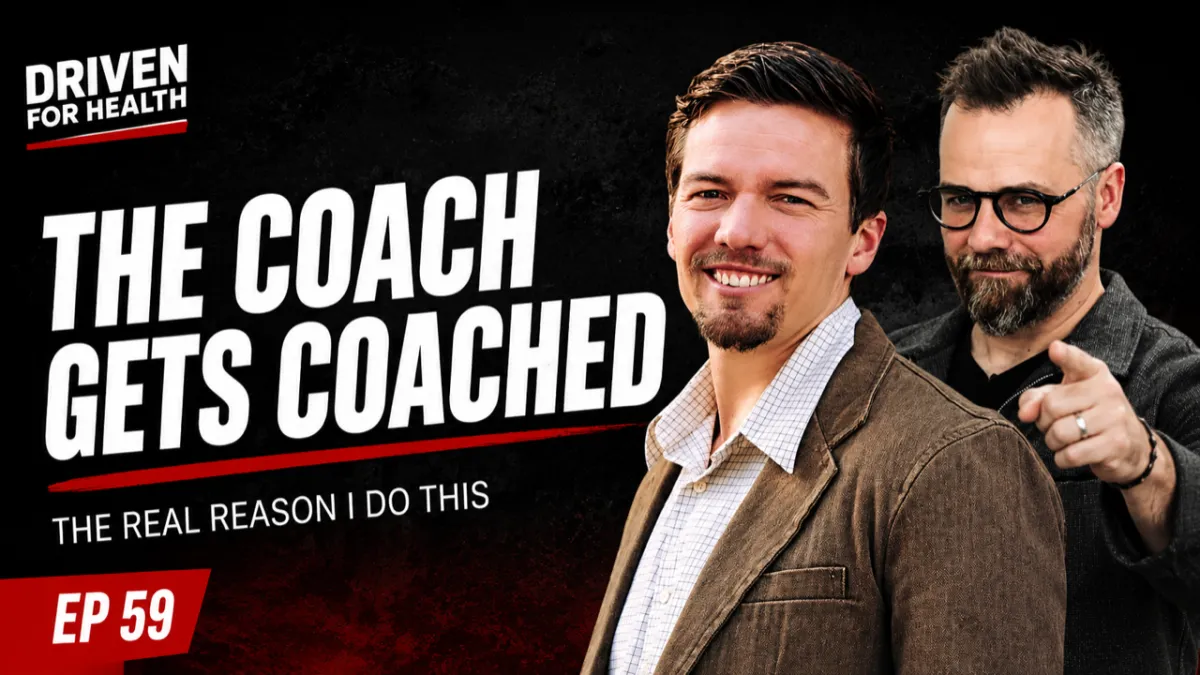
Driven men over 40 rarely lack information about their health. What they lack is somebody who asks the question they avoid asking themselves. Episode 59 puts Coach Brian in the client seat with Coach Jon Sheldon and shows what that question pulls out of a man who coaches for a living.
Coach Brian spends most episodes asking other men hard questions about their health. In episode 59 he hands over the chair. Returning guest Coach Jon Sheldon coaches him live through a four part personal performance blueprint, and what surfaces is the same bottleneck sitting under most driven men over 40.
The Coach Takes the Client Seat
Brian invited Jon back after their first conversation in episode 44. This time he asked for something different. He asked Jon to coach him on air.
Jon runs a framework he calls blueprints, briefs, and battle plans. The blueprint half builds a personal performance profile of one man. The briefs and battle plans half is a decision-making framework he built out of his years as a Marine Corps squad leader, after people kept asking him how he made fast calls under pressure. They ran out of time before they reached that second half.
Jon set one condition first. Brian had to answer from the gut, with nothing sent to him ahead of time. His reasoning is that a man given time to prepare writes answers he thinks sound good.
Step One: Purpose
Jon opened with one question. State your purpose in one unapologetic sentence.
Brian answered without a draft:
"Brian is here on this earth to give people hope, inspiration, and clarity on creating a fantastic life that they look forward to living, not only in the present, but in the future as well."
Jon calls purpose the cornerstone of the whole blueprint. It is the reason a man keeps going when the work gets hard, and it becomes the filter he runs later decisions through. He borrows the frame from Simon Sinek's book Start With Why.
Then came the two follow-ups that do the real work.
The first asks for a story. Name a time that purpose came under pressure, when tapping out would have been easier.
Brian went back to leaving the first gym he built. He and his business partner stopped seeing eye to eye, and Brian was the one who walked. Being a health coach was the only identity he had ever carried, so losing the gym meant losing his answer to who he was.
He also described what building that gym did to his body. A new baby at home. Four hours of sleep. Up at four in the morning to open the doors, back to bed near midnight. On a date night with his wife he could not keep his eyes open, and he held onto the car to stay upright.
The second follow-up is the one that stings. Where is your calendar out of alignment with the purpose you named a moment ago?
Brian did not soften it. He takes his laptop to his kid's soccer game and works through the match. He stays polite with the other parents and skips the conversation, because that conversation does not serve a purpose he can name. He carries dad guilt and husband guilt about where his hours go.
Then he said the line the rest of the episode hangs on:
"Brian can't keep up with Brian. Brian as a person cannot keep up with Brian as the identity, there's the friction, there it is."
Jon's response mattered as much as the question. He told Brian that nearly every male leader or business owner he takes on gives him close to that same answer.
Step Two: Vision
The vision question is simple to ask and hard to answer. If everything went right over the next three years, what does your life look like?
Brian described leading a movement in men's health, guiding men to be better for themselves and for the people who depend on them. The Call To Rise, his 100 day challenge, sits at the center of it.
Jon followed with the harder one. What scares you about that?
Brian named responsibility. A bigger version of this needs more people and more of him. Right now he plays head coach, sales, and marketing at once. He holds onto every piece because he believes he does each one best.
Then Jon made the move that separates a vision from a wish. He asked for three non-negotiable outcomes. Not dreams. Things that have to happen.
Two of them came out clearly. Reach and impact, with a bigger stage in front of the men he can serve. And a goal his family set together, one that only happens if his work keeps pace with it.
Jon pushed back on the stage answer. His test is blunt. If your life were a profession, what would you get fired for not doing by the end of today? A talk on a big stage does not survive that test. A non-negotiable does.
Step Three: Environment
Your surroundings either support the mission or sabotage it. Jon asked four questions here, fast.
What supports it today? Brian said connection. Real conversations with the men he can help, and with peers who reach back when he reaches out. He does his best work in rooms with people in them.
What sabotages it? The phone, by a mile. Brian went after the attention economy directly. He compared the hooks built into an app to the way processed food gets engineered to keep people buying it. Both run on habit. Both are built to be hard to put down.
His line to the men listening:
"Let's stop living life 10 seconds at a time, you're going to wake up 10 years from now and realize your dad was right, and you've wasted a lot of time on attention."
Who do you need closer? Brian answered in two words. His wife. When distance grows there, nothing else lands right.
Who do you need a boundary with? Brian named himself. One task rolls into the next until the workday has no edges.
What system do you upgrade in the next 90 days? Brian called it leverage. Getting organized enough that his best hours go to the work only he can do.
Step Four: Motivation
Jon's last set of questions goes after the internal battery. What energizes you? What drains you while looking productive? What recharges you when pressure hits?
Brian's energy comes from live conversation. Watching a man untie the knot he tied himself into is the part he called the juice.
What drains him is the marketing work. In his words:
"The marketing piece, wholeheartedly. It's not that I can't do it, it's not that I don't enjoy it, but that's not the job, that's not the mission, that's extra."
Every social post eats twenty to forty minutes and then fades. He used to spend his days talking with men about real problems. Now a large share of the week goes to producing content about talking with men.
Jon said he made the same call in his own practice and stepped back from that grind on purpose.
Then Jon asked what keeps the battery charged. Brian answered without hedging. Time with his wife. If he cannot connect with her, how well he is doing everywhere else stops mattering.
Where the Real Bottleneck Was
Jon closed by asking for one takeaway from the hour. Brian gave it in a single sentence:
"I need to connect with my wife more."
No part of that answer is about food or training. It is what was left after four rounds of questions cleared out everything that sounded impressive.
Jon had a version of the same moment in his own week. His wife questioned a business lunch he had scheduled with old friends, asking whether the one person who made it a business meeting would be there. She was right. He thanked her and fixed the invite.
That is what accountability looks like when it works. Somebody who knows you names the thing you were about to let slide, and you are close enough to them to hear it.
What This Means for Your Health After 40
For most men over 40 who are stuck on fat loss, information is not the gap. They can already name what to eat and how to move. The gap is a person who asks the question they will not ask themselves, and who is still there next week to hear the answer.
Episode 59 is a live demonstration of that. Brian coaches men for a living. He has an Exercise Science degree and 23 plus years of doing this work. He still needed somebody else in the room to reach the sentence about his wife, because that sentence is hard to say out loud.
The pattern underneath it is one Brian names for his own clients. Attention decides the result. When attention goes to the phone and the calendar and whatever is loudest, the body gets the leftovers.
Run This On Yourself This Week
You do not need a coach in the room for the first pass. Set aside twenty minutes and answer these out loud.
- Say your purpose out loud in one sentence. Do not edit it first.
- Name one place your calendar disagrees with that sentence. One is enough.
- Name what has to be true three years from now. Then run Jon's test on it. Would you get fired for not doing it by the end of today?
- Name the one thing sabotaging your environment. For most men it is the phone.
- Name the person you need closer, then tell them. Brian's own next step was carving out time to walk and talk with his wife.
- Name what drains you while looking productive. Decide whether you keep it or hand it off.
Then do the part that makes it count. Say your answers to somebody who will ask you about them again next week.
Where To Go From Here
If you want a live answer to your own version of this, bring it to the Health Hot Seat. Coach Brian works through one man's situation in front of the group, and you can submit yours at brianparana.short.gy/healthhotseatform.
If you want the accountability handled for you for the next 100 days, the work runs in three steps. Find the real reason your fat loss stopped. Build your food and your training around a 47 year old body, not a 27 year old one. Run it 100 days alongside other men doing the same thing.
The guarantee is plain. Lose 20 plus pounds in the 100 days, or Coach Brian keeps working with you until you do.
The Call To Rise is a 100-day Fat Loss Challenge designed for driven men ready to get back to a healthy body, boost their energy, and lead as a powerful man.
If you are struggling with some form of chronic illness such as high blood pressure, cholesterol or even Type 2 Diabetes - this program is designed for you too.
Through a proven system of strength training, personalized nutrition, and real accountability, most men lose 20 plus pounds and rebuild the confidence that comes with it and even improve chronic illness issues. It's more than a fitness program, it's a body transformation experience with a Brotherhood of like-minded men committed to showing up, leveling up, and leading in a body they are excited about.
This is your wake-up call to rise.
www.thecalltorise.com
Frequently Asked Questions
What is episode 59 of Driven For Health about?
Coach Brian hands the interview over to returning guest Coach Jon Sheldon and answers the questions himself. Jon walks him through a four part personal performance blueprint covering purpose, vision, environment, and motivation.
What is a personal performance blueprint?
It is Coach Jon Sheldon's four part profile of how one man works at his best. The four parts are purpose, vision, environment, and motivation. Jon builds it with a client before touching anything more specific.
Why do men over 40 need accountability for their health?
Most men over 40 can already name what to eat and how to train. What changes the result is somebody who asks the hard question and is still there the following week to hear the answer.
What does the purpose step ask you to do?
Three things. State your purpose in one unapologetic sentence. Name a time that purpose came under pressure and quitting would have been easier. Then name where your calendar and your relationships disagree with it today.
How do you turn a three year vision into something usable?
Coach Jon asks for non-negotiable outcomes rather than dreams. His test is whether you would get fired for not doing it by the end of the day. A goal that fails that test is a wish.
What did Coach Brian name as the biggest thing sabotaging his environment?
The phone. He compared the way apps hook attention to the way processed food is engineered to keep people buying it, and called it the biggest distraction he has.
What was Coach Brian's one takeaway from the session?
That he needs to connect with his wife more. He described that connection as the thing that keeps his internal battery charged and makes the early mornings and late nights worth it.
What is the Call To Rise program?
The Call To Rise is a 100 day fat loss challenge for driven men over 40, built on strength training, personalized nutrition, and real accountability. Most men lose 20 plus pounds.